


how financial institutions can gain better visibility into travel spend

How Financial Institutions Can Gain Better Visibility Into Travel Spend

Introduction

Business travel is a necessary expense for financial institutions, but limited visibility can lead to overspending, policy violations, and budgeting challenges. By centralizing travel management and using real-time insights, organizations can gain better control over travel costs, improve compliance, and make more informed financial decisions. 

Why Travel Spend Visibility Matters More Than Ever

Travel is often one of the largest discretionary expenses within a financial institution. Unlike fixed operational costs, travel spending can fluctuate significantly based on market conditions, client demands, and organizational growth.

Without visibility, finance teams face several challenges:

  • Budget overruns that are discovered too late
  • Difficulty forecasting future travel expenses
  • Inconsistent compliance with travel policies
  • Limited negotiating power with travel suppliers
  • Poor understanding of spending trends across departments

The problem isn’t necessarily excessive travel. The problem is not knowing where money is being spent until after the expense has occurred.

Why Travel Costs Often Go Unnoticed Until It’s Too Late

One of the biggest challenges financial institutions face is delayed visibility.

An employee books a flight through one platform, reserves a hotel through another, uses a corporate card for meals, and submits expenses weeks later. By the time finance teams review the reports, there is little opportunity to influence spending behavior.

This reactive approach creates several problems:

  • Overspending remains undetected
  • Budget tracking becomes inaccurate
  • Cost-saving opportunities are missed
  • Financial reporting becomes more complex

Solution

Organizations should focus on creating a structured travel process where spending can be monitored throughout the travel lifecycle rather than only after reimbursement claims are submitted.

The earlier spending becomes visible, the easier it is to control.

The Hidden Cost of Out-of-Policy Travel

Many organizations assume occasional policy exceptions have little impact. In reality, small deviations can create significant annual costs.

Examples include:

  • Last-minute flight bookings
  • Premium cabin upgrades
  • Non-preferred hotel selections
  • Unapproved travel expenses

Individually, these decisions may seem minor. Across hundreds or thousands of trips, they can substantially increase travel budgets.

Solution

Rather than focusing solely on enforcement, financial institutions should regularly analyze why policy violations occur.

Common causes include:

  • Policies that are outdated
  • Lack of employee awareness
  • Approval delays
  • Limited access to compliant travel options

Understanding the root cause helps organizations improve compliance without creating friction for travelers.

Why Fragmented Travel Data Creates Budgeting Challenges

Many financial institutions have access to travel data, but not in a format that supports decision-making.

Flight bookings may sit in one system. Hotel invoices may exist in another. Expense claims may be stored elsewhere.

As a result, finance leaders often struggle to answer questions such as:

  • Which departments generate the highest travel costs?
  • Which routes are becoming more expensive?
  • Are travel budgets aligned with business priorities?

Without consolidated information, budgeting becomes an exercise in estimation rather than analysis.

Solution

Travel data should be reviewed holistically rather than as separate transactions.

A complete view of travel spending enables better forecasting, stronger financial planning, and more informed business decisions.
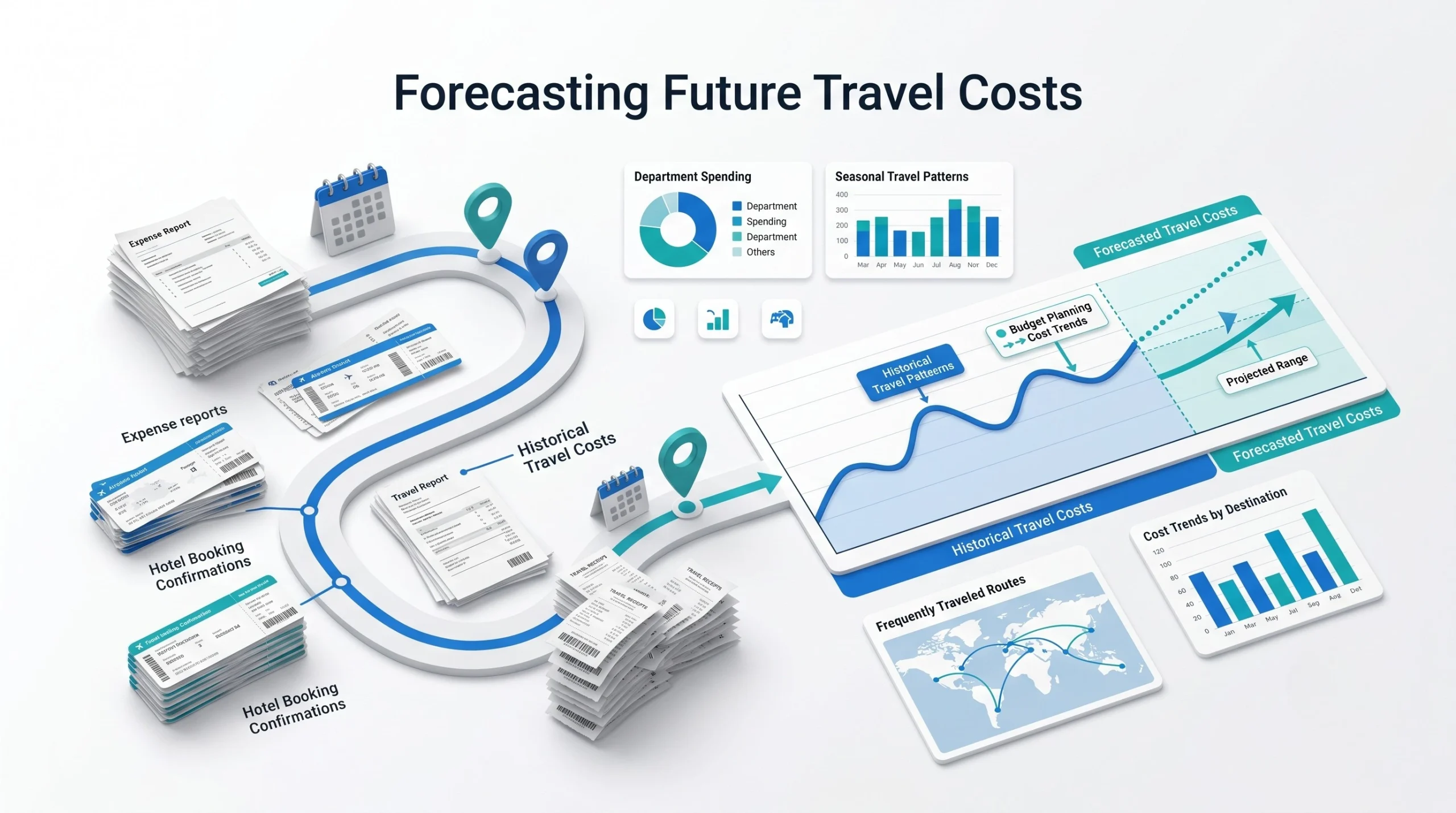
the challenge of forecasting future travel costs

The Challenge of Forecasting Future Travel Costs

Forecasting travel budgets has become increasingly difficult.

Airfares fluctuate regularly. Hotel rates change based on demand. Business expansion creates new travel requirements.

When organizations rely on incomplete historical data, forecasts become less reliable.

The result is often one of two outcomes:

  • Budgets are set too high, reducing financial efficiency.
  • Budgets are set too low, creating unexpected overruns.

Solution

Finance teams should regularly analyze historical travel trends, including:

  • Department-level spending
  • Seasonal travel patterns
  • Frequently traveled routes
  • Cost trends by destination

Data-driven forecasting leads to more accurate budget planning.

When Cost Reduction Efforts Backfire

During periods of economic uncertainty, organizations often look for ways to reduce travel spending.

However, aggressive cost-cutting can sometimes create unintended consequences.

For example:

  • Employees may spend more time arranging travel manually.
  • Lower-cost options may reduce productivity.
  • Client-facing teams may miss important relationship-building opportunities.

The goal should not be to eliminate travel spending.

The goal should be to ensure that travel investments generate business value.

Solution

Evaluate travel effectiveness alongside travel cost.

Ask questions such as:

  • Did the trip contribute to revenue generation?
  • Was the travel necessary?
  • Could objectives have been achieved differently?

This approach creates smarter spending decisions.

How Poor Visibility Impacts Supplier Negotiations

Many financial institutions underestimate the value of their travel purchasing power.

Without clear spending data, organizations struggle to negotiate favorable agreements with airlines, hotels, and travel providers.

This often results in missed opportunities for:

  • Corporate discounts
  • Preferred rates
  • Flexible booking terms
  • Volume-based incentives

Solution

Use travel spending insights to identify:

  • Most frequently used airlines
  • Preferred hotel chains
  • High-volume travel routes
  • Seasonal travel demand

Better data strengthens negotiating leverage and can generate substantial savings over time.

Turning Travel Data Into Strategic Decision-Making

The most successful financial institutions no longer view travel as an administrative expense.

Instead, they treat travel spend as a strategic business metric.

When organizations understand:

  • Who is traveling
  • Why they are traveling
  • How much is being spent
  • Which trips generate value

They can make more informed decisions about budgeting, resource allocation, and business growth.

Travel data becomes more than a record of expenses. It becomes a source of business intelligence.

Best Practices for Improving Travel Spend Visibility

Financial institutions looking to improve visibility should focus on the following:

Establish Clear Travel Policies

Policies should be practical, easy to understand, and aligned with business objectives.

Standardize Travel Processes

Consistent booking and approval processes reduce complexity and improve oversight.

Review Travel Data Regularly

Monthly reviews help identify spending trends before they become budget concerns.

Improve Cross-Department Collaboration

Finance, procurement, HR, and travel teams should work together to manage travel programs effectively.

Focus on Data Quality

Accurate data is essential for meaningful analysis and decision-making.

Frequently Asked Questions

Why is travel spend visibility important for financial institutions?

It helps organizations control costs, improve budgeting accuracy, strengthen compliance, and identify opportunities for savings.

What causes poor visibility into travel expenses?

Common causes include fragmented booking channels, delayed expense reporting, inconsistent policies, and disconnected data systems.

How can financial institutions reduce unnecessary travel spending?

By analyzing spending patterns, improving policy compliance, and regularly reviewing travel performance against business objectives.

What are the biggest travel spend risks for financial institutions?

Budget overruns, policy violations, duplicate expenses, and missed supplier savings opportunities are among the most common risks.

How often should travel spending be reviewed?

Most organizations benefit from monthly reviews, with quarterly strategic assessments to identify long-term trends.

Conclusion

For financial institutions, visibility is the foundation of effective cost management. Organizations cannot optimize what they cannot see.

By addressing fragmented data, improving policy compliance, strengthening forecasting, and analyzing travel trends more strategically, finance leaders can gain greater control over travel budgets while supporting business growth.

The institutions that manage travel spending most effectively are not necessarily those that spend the least. They are the ones that understand exactly where their travel investment is going and the value it delivers.

Ready to Gain Better Control Over Corporate Travel?

AtYourPrice helps financial institutions simplify travel management, improve spend visibility, and make smarter travel decisions through a centralized and data-driven approach.

Book a demo today to learn how your organization can gain greater transparency, stronger compliance, and better control over corporate travel spend.


red-eye flights tips for business travellers

Red-Eye Flights: Tips for Business Travellers

You land at 5:30 a.m. local time. Your inbox is already full. A client meeting starts at 9:00. The coffee helps, but not enough.

Red-eye flights are a familiar trade-off in business travel. They promise time saved and fewer daylight hours lost in transit. Yet they often leave professionals tired, foggy, and less prepared than they would like.

For business travellers, overnight flights can either sharpen efficiency or quietly erode performance. The difference lies in preparation. This guide offers practical, field-tested red-eye flight tips to help you arrive focused, presentable, and ready to work.

Why Business Travellers Choose Red-Eye Flights

A red-eye flight typically departs late at night and arrives early the next morning. For corporate travel, that timing can be attractive.

Common reasons professionals book overnight flights include:

  • Preserving daytime work hours
  • Reducing the need for an extra hotel night
  • Aligning with early meetings or conferences
  • Maximising time at the destination
  • Securing lower airfare compared to peak daytime routes

In competitive industries, the ability to step off a plane and walk into a meeting matters. But that efficiency only works if your energy holds up.

The Real Challenge: Sleep Deprivation and Performance

Research from the National Sleep Foundation shows that adults need seven to nine hours of sleep per night for optimal cognitive function. Most red-eye travellers fall short.

Even mild sleep deprivation can affect:

  • Decision-making
  • Reaction time
  • Emotional regulation
  • Memory recall
  • Presentation clarity

For professionals presenting to clients or negotiating contracts, these factors are not minor inconveniences. They directly influence outcomes.

The goal is not to avoid red-eye flights altogether. It is to manage them intelligently.

How to Prepare Before a Red-Eye Flight

Adjust Your Sleep Schedule in Advance

If possible, shift your sleep schedule by one to two hours in the days before departure.

For eastbound travel:

  • Go to bed slightly earlier
  • Reduce evening screen exposure
  • Wake up earlier

For westbound travel:

  • Stay up a little later
  • Get evening light exposure

Small adjustments can reduce the shock to your system.

Choose the Right Seat Strategically

Seat selection is not cosmetic. It influences your rest quality.

  • Window seats allow you to lean against the wall and control light exposure
  • Avoid seats near galleys or lavatories where noise increases
  • Bulkhead seats offer space but sometimes restrict armrests
  • Exit rows provide legroom but may not recline

If your company travel policy allows it, upgrading to premium economy on long-haul red-eye flights can significantly improve sleep posture.

Pack a Compact Sleep Kit

Business travellers often focus on laptop chargers and presentation clickers. Sleep tools deserve equal priority.

Consider carrying:

  • Noise-cancelling headphones
  • An eye mask
  • A small neck pillow
  • Compression socks
  • A refillable water bottle

These items take little space yet make a measurable difference in comfort.

What to Do at the Airport

Eat Light Before Boarding

Heavy meals before a red-eye flight can disrupt sleep and digestion.

Opt for:

  • Lean protein
  • Complex carbohydrates
  • Limited sugar
  • Minimal alcohol

Alcohol may feel relaxing, but it fragments sleep cycles and increases dehydration.

Stay Hydrated

Cabin air is dry. Dehydration contributes to fatigue and headaches.

Drink water before boarding and during the flight. Limit caffeine after mid-afternoon, especially on eastbound routes.

In-Flight Strategies for Better Rest

Sleep Early, Not After the Meal Service

On overnight flights, cabin service often delays sleep. If rest is your priority:

  • Consider skipping the full meal
  • Request a light snack instead
  • Signal to flight attendants that you prefer not to be disturbed

The earlier you sleep, the more complete your rest cycle.

Use Time-Zone Alignment

Adjust your watch to the destination time as soon as you board.

If it is nighttime at your destination, sleep. If it is nearing morning, aim for shorter rest and plan for strategic naps later.

This approach helps regulate circadian rhythm disruption.

Avoid Excessive Screen Time

Blue light exposure interferes with melatonin production.

If you must review slides or answer emails:

  • Lower screen brightness
  • Use night mode settings
  • Stop at least 30 minutes before attempting sleep

Your brain needs a clear signal that it is time to rest.

Landing Smart: The First Six Hours Matter

Arriving early in the morning creates a decision point. Do you push through or find a place to rest?

Book Early Check-In When Possible

If your meeting is later in the day, reserve a hotel room with guaranteed early check-in.

Short rest strategies include:

  • A 60 to 90 minute nap
  • A shower to refresh circulation
  • Light stretching

Even brief rest can restore mental sharpness.

Use Natural Light to Reset

Exposure to daylight helps recalibrate your internal clock.

Step outside if possible. Walk for ten to fifteen minutes. Light movement improves alertness more effectively than another coffee.

Red-Eye Flights and Corporate Travel Policy

Many corporate travel policies address cost control but overlook traveller wellbeing.

Forward-thinking organisations now consider:

  • Minimum flight duration thresholds for overnight bookings
  • Approved cabin classes for long-haul red-eyes
  • Rest policies before critical meetings
  • Travel risk management protocols

Guidance from industry bodies such as the Global Business Travel Association highlights the connection between traveller wellbeing and productivity.

For HR and finance teams, red-eye flights are not just a cost decision. They are a performance variable.

health and safety considerations

Health and Safety Considerations

Manage Circulation on Long Flights

Extended sitting increases the risk of circulation issues.

The Centers for Disease Control and Prevention recommends:

  • Standing every two to three hours
  • Flexing ankles and calves
  • Wearing compression stockings on longer routes

Movement supports both physical comfort and cognitive clarity.

Protect Immune Health

Business travel exposes professionals to crowded environments.

Strengthen your resilience by:

  • Getting adequate sleep before departure
  • Staying hydrated
  • Washing hands frequently
  • Avoiding face touching

A single illness can disrupt multiple meetings.

Technology Tools That Help

Smart tools can make overnight travel smoother.

Useful options include:

  • Sleep tracking apps to monitor rest cycles
  • Airline apps for gate updates and seat management
  • Corporate travel management platforms for itinerary tracking
  • Expense tools for real-time receipt capture

Internal link suggestion:

  • “Real-Time Travel and Expense Management: A Guide for Finance and HR Leaders”

External link suggestion:

  • Sleep health resources from the National Sleep Foundation

Integrated travel dashboards also help companies track patterns in overnight travel frequency and associated costs.

When Red-Eye Flights Make Sense and When They Do Not

Not every itinerary benefits from overnight travel.

Red-eyes work best when:

  • Meetings start mid-morning or later
  • Travel time exceeds five hours
  • You can secure uninterrupted rest
  • The trip is short and tightly scheduled

They may not be ideal when:

  • Presentations require peak cognitive performance early morning
  • You have existing sleep deficits
  • The flight is under four hours
  • Recovery time is unavailable

Business travel efficiency must account for human limits.

Practical Checklist for Business Travellers

Before Booking:

  • Confirm meeting start times
  • Assess time-zone difference
  • Review company travel policy
  • Consider cabin comfort

Before Departure:

  • Adjust sleep schedule
  • Pack a sleep kit
  • Eat light
  • Hydrate well

On Arrival:

  • Seek daylight exposure
  • Nap strategically if needed
  • Avoid excessive caffeine
  • Schedule high-focus tasks after peak alertness

Small steps compound into better performance.

The Financial Perspective: Cost Versus Productivity

From a finance standpoint, red-eye flights often reduce:

  • Hotel nights
  • Daytime productivity loss
  • Higher daytime airfare costs

However, hidden costs include:

  • Reduced meeting effectiveness
  • Slower decision-making
  • Increased health strain
  • Burnout risk

The most effective corporate travel strategy balances direct savings with performance sustainability.

FAQ: Red-Eye Flights for Business Travellers

Are red-eye flights good for business travel?

They can be efficient for preserving work hours and reducing hotel stays. However, they require proper planning to avoid fatigue-related performance issues.

How can I sleep better on a red-eye flight?

Choose a window seat, use an eye mask and noise-cancelling headphones, avoid heavy meals and alcohol, and align sleep with the destination time zone.

Is it better to work or sleep on an overnight flight?

For most professionals, prioritising sleep improves next-day performance more than completing additional work mid-flight.

Should companies allow premium seating for red-eye flights?

For long-haul overnight travel, enhanced seating may improve rest quality and meeting effectiveness, particularly for senior leaders or client-facing roles.

How do you avoid jet lag after a red-eye?

Adjust sleep patterns before departure, align with destination time upon boarding, seek natural light after arrival, and stay hydrated.

Final Thoughts: Travel Smart, Perform Better

Red-eye flights are part of modern corporate travel. They offer efficiency, flexibility, and sometimes cost savings. Yet they also demand thoughtful preparation.

Business travellers who manage sleep, hydration, timing, and recovery arrive sharper and more effective. Companies that recognise the productivity implications of overnight travel build stronger travel policies.

If your organisation wants better visibility into travel patterns, traveller wellbeing, and policy compliance, now is the time to act.

Contact our team to explore how a modern travel and expense management platform can help you optimise overnight travel decisions, improve reporting accuracy, and support employee performance. Book a demo today and make every mile count.

managing multi-city employee travel without losing budget control

Managing Multi-City Employee Travel Without Losing Budget Control

Business growth often brings a new challenge: managing employee travel across multiple cities. Sales teams visit clients, project managers oversee operations, executives attend meetings, and support teams travel for on-site assistance. While these trips are essential, they can quickly become one of the largest operational expenses if not managed properly.

For many organizations, the problem isn’t travel itself. The real challenge is maintaining visibility, compliance, and cost control when employees are constantly moving between locations.

Without a structured travel management strategy, expenses rise, policies are ignored, bookings become fragmented, and finance teams struggle to track spending accurately.

The good news is that businesses can effectively manage multi-city employee travel without sacrificing productivity or exceeding budgets. By combining clear policies, centralized booking systems, and data-driven decision-making, organizations can reduce travel costs while improving employee experience.

Why Multi-City Employee Travel Is Difficult to Manage

Managing travel for a single office location is relatively straightforward. However, as organizations expand across cities, travel complexity increases significantly.

Common challenges include:

  • Inconsistent travel bookings across departments
  • Last-minute flight and hotel reservations
  • Lack of visibility into travel expenses
  • Travel policy violations
  • Duplicate or unnecessary trips
  • Difficulty tracking employee movements
  • Limited supplier negotiation power

When multiple teams book travel independently, companies lose control over spending and miss opportunities to optimize costs.

This is why many growing organizations partner with the best travel agency in India or adopt dedicated travel management platforms to centralize and streamline the process.

The Hidden Costs of Poor Travel Management

Most businesses focus only on visible expenses such as flights and hotels. However, unmanaged travel creates several hidden costs that often go unnoticed.

Last-Minute Bookings

Flights booked just a few days before departure can cost significantly more than those booked in advance.

For example:When dozens or hundreds of employees travel regularly, these differences add up quickly.

Travel Leakage

Travel leakage occurs when employees book outside approved channels.

Examples include:

  • Booking directly through airline websites
  • Using personal travel apps
  • Selecting non-approved hotels
  • Paying personally and seeking reimbursement later

This reduces visibility and prevents businesses from accessing negotiated corporate rates.

Administrative Burden

Finance and HR teams often spend countless hours reviewing travel claims, verifying receipts, and processing reimbursements.

A lack of automation increases both costs and operational inefficiencies.

Create a Centralized Travel Policy

One of the most effective ways to maintain budget control is by establishing a clear corporate travel policy.

The policy should define:

Booking Guidelines

Specify:

  • Approved booking channels
  • Preferred airlines
  • Hotel categories
  • Advance booking requirements

Approval Workflows

Define who can approve travel requests and under what circumstances.

This prevents unnecessary travel and ensures accountability.

Expense Limits

Set spending thresholds for:

  • Flights
  • Accommodation
  • Meals
  • Ground transportation

Clear limits reduce overspending while maintaining employee comfort.

Standardize Travel Booking Across Locations

A common mistake businesses make is allowing each office or department to manage travel independently.

Instead, organizations should centralize bookings through a single travel management solution or work with a top travel agency in India that can oversee travel requirements across all locations.

Benefits include:

  • Consistent policy enforcement
  • Better reporting
  • Reduced travel leakage
  • Stronger supplier negotiations
  • Improved traveler support

Centralized booking creates transparency and gives finance teams greater control over spending.

Leverage Corporate Airline and Hotel Agreements

Companies with frequent multi-city travel have significant purchasing power.

Unfortunately, many organizations fail to use that leverage effectively.

Airline Partnerships

Corporate agreements can provide:

  • Discounted fares
  • Flexible cancellations
  • Dedicated support
  • Priority services

Hotel Negotiations

Preferred hotel programs often offer:

  • Lower room rates
  • Complimentary upgrades
  • Flexible check-in and checkout
  • Loyalty benefits

Partnering with a top travel company in India can help businesses secure better rates through established supplier relationships.

encourage advance travel planning

Encourage Advance Travel Planning

One of the simplest ways to reduce travel expenses is encouraging employees to plan ahead.

Why Advance Booking Matters

Airlines and hotels use dynamic pricing models.

As availability decreases, prices increase.

Booking travel 2–3 weeks in advance often reduces airfare and accommodation costs 

Practical Strategies

Businesses can encourage early bookings by:

  • Requiring advance approval
  • Setting minimum booking windows
  • Monitoring booking behavior
  • Rewarding policy compliance

Small behavioral changes can produce significant annual savings.

Use Travel Data to Identify Spending Trends

You cannot control what you cannot measure.

Many organizations collect travel data but fail to analyze it effectively.

Tracking key travel metrics helps uncover opportunities for optimization.

Essential Metrics to Monitor

  • Average trip cost
  • Cost per employee
  • Department-wise travel spending
  • Advance booking rate
  • Hotel cost per night
  • Cancellation percentage
  • Travel policy compliance rate

Regular reporting enables businesses to make informed decisions rather than relying on assumptions.

Optimize Travel Frequency Without Reducing Productivity

Not every meeting requires a flight.

Before approving travel requests, organizations should evaluate whether travel is truly necessary.

Ask questions such as:

  • What business outcome is expected?
  • Can the objective be achieved virtually?
  • Is the travel revenue-generating?
  • Does it strengthen critical client relationships?

A balanced approach allows businesses to reduce unnecessary trips while maintaining operational effectiveness.

Improve Employee Experience While Controlling Costs

Cost reduction should never come at the expense of employee satisfaction.

Travelers who face complicated booking processes or poor accommodations often experience lower productivity.

Focus on Convenience

Provide employees with:

  • Easy booking options
  • Mobile access
  • 24/7 travel support
  • Transparent travel policies

When employees understand the rules and have access to approved options, compliance naturally improves.

Balance Cost and Comfort

Choosing the cheapest option is not always the smartest decision.

A slightly more expensive flight with better timing may reduce fatigue and improve productivity.

Successful travel management balances financial control with employee well-being.

Why Businesses Are Choosing Travel Management Partners

As travel programs grow, managing everything internally becomes difficult.

Many organizations now rely on travel agencies to streamline operations and improve cost control.

A professional travel management partner can help with:

  • Multi-city travel planning
  • Corporate rate negotiations
  • Traveler support
  • Travel policy implementation
  • Reporting and analytics
  • Cost optimization strategies

The right partner acts as an extension of your business, helping you manage travel efficiently while reducing operational burdens.

Best Practices for Managing Multi-City Employee Travel

To summarize, organizations should focus on the following:

Establish Clear Policies

Create standardized travel rules and communicate them consistently.

Centralize Bookings

Use a single platform or travel management partner.

Monitor Spending

Track travel expenses regularly and benchmark performance.

Negotiate Supplier Rates

Leverage travel volume for better pricing.

Encourage Advance Planning

Reduce costs through early bookings.

Reduce Travel Leakage

Ensure employees use approved booking channels.

Automate Processes

Streamline approvals, expenses, and reporting.

These practices help organizations maintain visibility and budget control even as travel volumes increase.

Frequently Asked Questions

How can companies reduce multi-city travel costs?

Businesses can reduce costs through centralized booking, advance planning, negotiated supplier rates, automated travel management systems, and stronger policy compliance.

Why is centralized travel booking important?

Centralized booking improves visibility, enforces travel policies, reduces travel leakage, and helps organizations negotiate better corporate rates.

What is travel leakage?

Travel leakage occurs when employees book outside approved channels, causing businesses to lose visibility and miss negotiated discounts.

How does a travel management company help businesses?

A travel management company assists with booking, supplier negotiations, traveler support, reporting, compliance monitoring, and cost optimization.

What are the benefits of working with the best travel agency in India?

Businesses gain access to better rates, streamlined travel processes, expert support, and improved control over corporate travel spending.

How can travel technology improve budget control?

Travel technology provides real-time visibility, automates approvals, tracks expenses, enforces policies, and generates actionable analytics for better decision-making.

Take Control of Multi-City Travel Spending

Managing employee travel across multiple cities doesn’t have to result in budget overruns or operational headaches. With the right policies, technology, supplier relationships, and travel management strategy, businesses can improve visibility, strengthen compliance, and significantly reduce costs.

At AtYourPrice, we help organizations simplify corporate travel management, optimize travel spending, and deliver a seamless travel experience for employees across locations.

Ready to gain better control over your corporate travel budget? Book a demo with AtYourPrice today and discover a smarter way to manage multi-city employee travel.

reducing compliance risks through travel automation

Reducing Compliance Risks Through Travel Automation

Business travel is essential for growth. Whether it is meeting clients, attending industry events, conducting site visits, or managing operations across multiple locations, corporate travel keeps businesses moving forward.

However, every trip creates a chain of approvals, bookings, invoices, expense claims, tax records, and compliance requirements. When these processes are managed manually through emails, spreadsheets, and disconnected systems, the risk of compliance failures increases significantly.

A missed approval, an out-of-policy booking, an incomplete GST invoice, or an unreconciled expense report may seem like a minor issue in isolation. But when multiplied across hundreds or thousands of trips, these gaps can lead to financial losses, audit challenges, tax compliance issues, and operational inefficiencies.

This is why organizations are increasingly investing in corporate travel automation. By automating travel workflows and centralizing data, businesses can improve policy compliance, reduce administrative effort, strengthen financial controls, and create a more efficient travel management process.

In this article, we’ll explore how travel automation helps reduce compliance risks and why adopting an enterprise corporate travel platform has become a strategic priority for modern businesses.

Why Compliance Is a Critical Part of Corporate Travel

Corporate travel compliance is often misunderstood as simply ensuring employees follow a travel policy. In reality, it encompasses much more.

Every business trip must align with:

  • Company travel policies
  • Budgetary controls
  • Approval workflows
  • Expense management procedures
  • GST and tax regulations
  • Procurement guidelines
  • Internal audit requirements
  • Duty of care obligations

Without proper controls, organizations can quickly lose visibility into travel spending and expose themselves to compliance risks.

As businesses grow, managing these requirements manually becomes increasingly difficult. Multiple departments, numerous travelers, and growing travel volumes create complexity that traditional processes struggle to handle.

The result is often inconsistent policy enforcement, delayed approvals, inaccurate reporting, and compliance gaps that remain unnoticed until an audit or financial review uncovers them.

The Hidden Risks of Manual Travel Management

Many organizations continue to rely on outdated travel management processes because they appear familiar and cost-effective. However, manual workflows often create risks that are difficult to identify until they become serious problems.

Inconsistent Policy Enforcement

Most companies have travel policies designed to control costs and maintain consistency. However, policies are only effective when they are consistently followed.

In a manual environment:

  • Employees may book outside approved channels.
  • Managers may interpret policies differently.
  • Exceptions may not be documented properly.
  • Preferred suppliers may be bypassed.

Over time, these inconsistencies lead to higher travel costs and reduced compliance.

Approval Process Gaps

Approvals are a crucial control mechanism in corporate travel.

When approvals happen through email chains, phone calls, or messaging applications, organizations often face challenges such as:

  • Missing approval records
  • Delayed decision-making
  • Unauthorized bookings
  • Lack of accountability

Without a structured workflow, it becomes difficult to demonstrate compliance during audits.

Poor Documentation Management

Business travel generates a significant amount of documentation.

This includes:

  • Flight tickets
  • Hotel invoices
  • GST invoices
  • Approval records
  • Expense receipts
  • Reimbursement claims

When documents are stored across multiple systems or devices, retrieving them later can be time-consuming and error-prone.

Expense Reporting Errors

Manual expense management frequently results in:

  • Duplicate reimbursements
  • Missing receipts
  • Incorrect expense classifications
  • Calculation mistakes

These issues not only increase administrative workload but also create financial and compliance risks.

How Travel Automation Reduces Compliance Risks

Automated Policy Enforcement

One of the most effective ways to reduce compliance risks is to prevent violations before they occur.

Travel automation platforms enforce policies automatically during the booking process.

Examples include:

  • Flight fare limits
  • Hotel spending caps
  • Advance booking requirements
  • Preferred vendor selection
  • Class of travel restrictions

Employees are guided toward compliant choices from the beginning, reducing the need for corrective action later.

Standardized Approval Workflows

Automated workflows ensure that every travel request follows a predefined approval path.

Approvals can be configured based on:

  • Employee level
  • Department
  • Cost center
  • Trip budget
  • Destination
  • Travel purpose

This ensures consistency while maintaining a complete record of every approval decision.

Real-Time Visibility

Traditional travel management often provides visibility only after expenses have been incurred.

With automation, stakeholders gain real-time insights into:

  • Travel spending
  • Policy exceptions
  • Budget utilization
  • Approval status
  • Booking trends

This enables organizations to identify and address compliance issues before they escalate.

Complete Audit Trails

Every action within an automated travel platform is recorded.

Organizations can track:

  • Who submitted a request
  • Who approved it
  • When changes were made
  • Which policy rules were applied
  • What expenses were claimed

This level of transparency significantly simplifies audits and investigations.

The Role of GST Compliance in Corporate Travel

For businesses operating in India, GST compliance remains one of the most important aspects of travel management.

Travel-related expenses often involve multiple vendors, including airlines, hotels, transportation providers, and service partners.

Managing GST manually creates several challenges.

Common GST Compliance Issues

Finance teams frequently encounter:

  • Missing GST invoices
  • Incorrect GSTIN information
  • Delayed invoice collection
  • Manual reconciliation challenges
  • Lost Input Tax Credit opportunities

These issues can impact both compliance and financial performance.

How Automation Simplifies GST Management

A modern enterprise corporate travel platform helps organizations manage GST requirements more efficiently by:

  • Capturing invoices automatically
  • Centralizing tax documentation
  • Validating vendor information
  • Maintaining digital records
  • Supporting reconciliation workflows

This reduces the administrative burden on finance teams while improving accuracy.

benefits for finance teams

Benefits for Finance Teams

Finance departments are among the biggest beneficiaries of travel automation.

Better Spend Visibility

Travel automation provides real-time insights into:

  • Department-level spending
  • Vendor performance
  • Budget consumption
  • Cost trends

This supports more informed financial decision-making.

Reduced Administrative Work

Automation eliminates repetitive tasks such as:

  • Chasing approvals
  • Collecting invoices
  • Verifying expenses
  • Preparing reports

As a result, finance teams can focus on strategic initiatives rather than administrative activities.

Improved Reporting Accuracy

Accurate reporting depends on reliable data.

Automated systems reduce human error and ensure consistency across travel records, expenses, and compliance reports.

Key Features to Look for in an Enterprise Corporate Travel Platform

Choosing the right platform is critical.

Organizations should evaluate solutions based on their ability to support compliance, scalability, and operational efficiency.

Key features include:

Configurable Policy Controls

Every organization has unique travel requirements.

The platform should allow businesses to create customized travel policies and automate enforcement.

Multi-Level Approval Workflows

Flexible approval structures ensure governance while reducing bottlenecks.

Real-Time Reporting and Analytics

Comprehensive dashboards help stakeholders monitor compliance and spending trends.

GST and Tax Management

Built-in support for GST documentation and reconciliation is essential for Indian businesses.

Centralized Data Storage

All travel records, invoices, approvals, and reports should be accessible from a single location.

Scalability

As organizations grow, the platform should be able to handle increasing transaction volumes without additional complexity.

The Future of Corporate Travel Compliance

As business travel continues to evolve, compliance requirements will become increasingly complex.

Organizations will need greater visibility, faster reporting, stronger controls, and better data management.

Artificial intelligence, predictive analytics, and automated compliance monitoring are already reshaping travel management.

Companies that continue relying on manual processes risk falling behind both operationally and financially.

Organizations that embrace corporate travel automation will be better positioned to manage risk, control costs, and support growth.

Conclusion

Compliance risks in corporate travel rarely emerge overnight. They develop gradually through missed approvals, incomplete documentation, inconsistent policy enforcement, and fragmented data.

While these issues may appear manageable initially, they can quickly create financial, operational, and regulatory challenges as travel volumes increase.

By implementing corporate travel automation, organizations can standardize workflows, enforce policies automatically, improve GST compliance, simplify audits, and gain complete visibility into travel spend.

A modern enterprise corporate travel platform not only improves efficiency but also creates a stronger foundation for governance, accountability, and business growth.

Frequently Asked Questions

What is corporate travel automation?

Corporate travel automation uses technology to automate travel requests, approvals, bookings, expense management, compliance monitoring, and reporting.

How does travel automation improve compliance?

It enforces travel policies automatically, creates audit trails, centralizes documentation, and reduces manual errors that often lead to compliance issues.

Why is an enterprise corporate travel platform important?

An enterprise corporate travel platform provides centralized control over travel operations, helping organizations manage compliance, spending, reporting, and employee travel experiences more effectively.

Can travel automation help with GST compliance?

Yes. Automated platforms can capture invoices, validate GST information, maintain documentation, and support reconciliation processes.

What are the biggest compliance risks in business travel?

Common risks include unauthorized bookings, missing approvals, incomplete invoices, inaccurate expense reports, policy violations, and poor record management.

How does travel automation benefit finance teams?

Finance teams gain better visibility into travel spending, reduce manual work, improve reporting accuracy, simplify audits, and strengthen compliance controls.

Ready to Reduce Compliance Risks and Take Control of Corporate Travel?

Every travel request, approval, booking, invoice, and expense claim represents a compliance responsibility. Managing these processes manually increases risk, slows operations, and creates unnecessary work for finance, HR, procurement, and travel teams.

AtYourPrice helps organizations simplify travel management through intelligent automation and policy-driven workflows.

With AtYourPrice, your business can:

✔ Automate travel approvals through Email, WhatsApp, and Mobile App

✔ Enforce travel policies automatically during booking

✔ Gain real-time visibility into travel spend and compliance

✔ Centralize invoices, approvals, and travel documentation

✔ Simplify GST management and reconciliation processes

✔ Create audit-ready records for every travel transaction

✔ Scale travel operations without increasing administrative workload

Book a demo today and discover how AtYourPrice can help your organization reduce compliance risks, improve operational efficiency, and gain complete control over business travel.

the growing importance of travel data in financial audits

The Growing Importance of Travel Data in Financial Audits

Corporate travel generates far more than flight tickets and hotel invoices. Every trip creates a trail of financial records, approvals, tax documents, and expense claims that eventually become part of a company’s financial reporting process.

The challenge is that many organisations still manage travel data across multiple systems. Employees book through different channels, approvals happen over email, and expenses are reconciled weeks after a trip is completed. When audit season arrives, finance teams often find themselves searching for missing records, verifying approvals, and explaining discrepancies.

As business travel spending continues to grow, travel data is becoming one of the most important components of financial audits. Accurate, accessible, and real-time travel information helps organisations strengthen compliance, improve spend visibility, and simplify audit preparation.

In this guide, we’ll explore why travel data matters, the risks of poor travel data management, and how companies can build audit-ready travel programs.

Why Travel Data Matters More Than Ever During Financial Audits

Business travel is no longer a simple expense category.

A single trip may involve multiple vendors, payment methods, tax documents, and approvals. Every transaction must be properly recorded, categorised, and supported with documentation.

This is where travel data becomes essential.

Travel data includes:

  • Flight and hotel booking information
  • Employee and department details
  • Travel approvals
  • Expense records
  • Tax invoices and GST documentation
  • Refunds and cancellations
  • Policy compliance records

For auditors, this information provides evidence that travel spending is legitimate, properly approved, and accurately reported.

For finance teams, it provides visibility into where money is being spent and whether company policies are being followed.

The importance of travel data has increased because organisations today face greater expectations around:

  • Financial transparency
  • Regulatory compliance
  • Cost control
  • Tax reporting accuracy
  • Internal governance

Without reliable travel data, these objectives become difficult to achieve.

Common Pain Points Finance Teams Face

Many audit challenges originate long before the audit begins.

Some of the most common issues include:

  • Missing invoices and receipts
  • Duplicate expense claims
  • Out-of-policy bookings
  • Unclear approval records
  • Inconsistent travel reporting
  • Difficulty tracking GST credits
  • Manual reconciliation across multiple systems

These problems create additional work for finance teams and increase the likelihood of audit findings.

The Audit Risks Hidden Inside Poor Travel Data

Travel spending often involves hundreds or even thousands of transactions every year. When travel data is fragmented, audit risks increase significantly.

Missing Documentation

Auditors need evidence for every expense.

If invoices, booking confirmations, or approval records cannot be located quickly, finance teams must spend valuable time reconstructing information.

This not only delays audits but can also raise questions about internal controls.

Policy Compliance Gaps

Most organisations maintain travel policies covering:

  • Flight class eligibility
  • Hotel budgets
  • Approval workflows
  • Expense limits

When travel data is incomplete, it becomes difficult to verify whether employees followed these guidelines.

As a result, compliance issues may remain hidden until an audit review.

Duplicate and Incorrect Claims

Manual expense processes often create opportunities for errors.

Employees may accidentally submit the same expense twice, or finance teams may approve claims without complete verification.

Without consolidated travel data, these mistakes are difficult to identify.

Tax and GST Compliance Challenges

Travel expenses often contain tax implications.

Missing invoices or incorrect supplier information can lead to:

  • Lost GST input tax credits
  • Inaccurate financial reporting
  • Additional scrutiny during tax audits

For Indian businesses, maintaining accurate travel-related tax records has become increasingly important as compliance requirements continue to evolve.

Limited Spend Visibility

One of the biggest risks is the inability to understand overall travel spending.

Finance leaders frequently struggle to answer questions such as:

  • Which departments spend the most on travel?
  • Which routes generate the highest costs?
  • How much spending occurs outside approved channels?

Without complete travel data, these insights remain difficult to obtain.

What Good Travel Data Reveals

Many companies view travel data simply as a record-keeping requirement.

In reality, it can become a powerful decision-making tool.

When travel information is centralised and accurate, it provides insights that go far beyond audit preparation.

Better Travel Spend Visibility

Travel data helps organisations understand:

  • Total travel expenditure
  • Department-wise spending
  • Cost centre allocations
  • Supplier performance

This visibility enables more informed budgeting and forecasting decisions.

Improved Policy Compliance

Travel data allows companies to measure:

  • Compliance rates
  • Approval trends
  • Policy exceptions
  • Booking behaviour

Instead of discovering issues months later, finance teams can identify patterns in real time.

Stronger Fraud Detection

Detailed travel reporting makes it easier to detect unusual activity.

Examples include:

  • Duplicate expense claims
  • Excessive spending patterns
  • Repeated policy violations
  • Unapproved bookings

These insights strengthen internal controls and reduce financial risk.

more accurate budget planning

More Accurate Budget Planning

Historical travel data provides valuable forecasting information.

Finance teams can use travel trends to:

  • Predict future spending
  • Build realistic budgets
  • Identify seasonal patterns
  • Evaluate supplier contracts

This transforms travel management from a reactive process into a strategic function.

Faster and More Efficient Audits

Perhaps the most obvious benefit is audit readiness.

When records are centralised and accessible, auditors can review transactions more efficiently.

This reduces:

  • Audit preparation time
  • Administrative workload
  • Manual reconciliation efforts

How Technology Makes Travel Audits Easier

Manual spreadsheets and disconnected systems were never designed for modern audit requirements.

As travel volumes grow, technology becomes essential for maintaining accurate and audit-ready records.

Centralised Travel Management

A centralised travel platform creates a single source of truth.

Instead of collecting information from multiple systems, finance teams can access:

  • Booking records
  • Expense reports
  • Approval histories
  • Compliance data

from one location.

This dramatically improves data accuracy and reporting consistency.

Automated Approval Workflows

Approvals are a critical component of audit reviews.

Modern travel management systems automatically record:

  • Approval requests
  • Approval dates
  • Approver details
  • Policy exceptions

This creates a clear audit trail without relying on email chains.

Real-Time Reporting and Dashboards

Real-time reporting gives finance teams immediate visibility into travel spending.

Instead of waiting for month-end reports, organisations can monitor:

  • Current travel expenses
  • Policy compliance rates
  • Departmental spending
  • Booking trends

This allows issues to be addressed before they become audit concerns.

Integrated Travel and Expense Management

One of the biggest challenges in financial audits is matching bookings to expense claims.

Integrated systems automatically connect:

  • Travel bookings
  • Invoices
  • Expense submissions
  • Reimbursements

This simplifies reconciliation and improves financial accuracy.

Platforms such as AtYourPrice help organisations move toward a more connected travel management environment where visibility, compliance, and reporting work together seamlessly.

Five Practical Steps to Build an Audit-Ready Travel Program

Improving travel data quality does not require a complete transformation overnight.

Most organisations can achieve significant improvements by focusing on a few key areas.

1. Standardise Travel Bookings

Encourage employees to use approved booking channels.

Consistent booking behaviour creates cleaner data and better visibility.

2. Centralise Travel Records

Store bookings, approvals, invoices, and expenses within a unified system whenever possible.

Centralisation reduces data gaps and simplifies reporting.

3. Automate Approval Processes

Replace manual approval methods with structured workflows that create permanent audit trails.

4. Monitor Compliance Regularly

Track policy compliance throughout the year rather than waiting for audit season.

Early intervention prevents larger problems later.

5. Review Travel Data Frequently

Regular reporting helps finance teams identify:

  • Cost trends
  • Compliance issues
  • Data quality concerns
  • Savings opportunities

The best time to prepare for an audit is long before the audit begins.

Frequently Asked Questions

Why is travel data important in financial audits?

Travel data provides evidence of spending, approvals, compliance, and tax documentation, helping auditors verify the accuracy of financial records.

What travel records should companies keep for audits?

Companies should retain invoices, booking confirmations, expense reports, approval records, reimbursement details, and GST-related documents.

How does travel data improve compliance?

Travel data helps organisations track policy adherence, approval workflows, and spending behaviour, making compliance easier to monitor and enforce.

What are the biggest travel audit risks?

Common risks include missing documentation, duplicate claims, policy violations, inaccurate expense reporting, and incomplete tax records.

How can travel management software help finance teams?

Travel management software centralises data, automates approvals, improves reporting, and creates audit-ready records that simplify financial reviews.

What metrics should finance leaders track?

Important metrics include travel spend, compliance rates, average trip cost, cancellation rates, booking behaviour, and department-level travel expenses.

Conclusion

Travel data is no longer just an operational record. It has become a critical financial asset.

As organisations face increasing pressure to improve compliance, transparency, and cost control, accurate travel data provides the foundation for stronger financial governance. It helps finance teams prepare for audits, identify risks, monitor spending, and make better business decisions.

Companies that continue to rely on fragmented travel processes often face unnecessary challenges during audits. Those that invest in centralised travel management gain greater visibility, stronger compliance controls, and more reliable reporting.

If your organisation wants to simplify audit preparation and gain complete visibility into travel spend, it may be time to rethink how travel data is managed.

Book a demo with AtYourPrice today and discover how a unified travel platform can help your finance team improve compliance, streamline audits, and take control of corporate travel data.

smart strategies to optimize corporate travel budgets

Smart Strategies to Optimize Corporate Travel Budgets

Corporate travel plays a major role in business growth, client relationships, sales expansion, networking, and team collaboration. Yet for many organizations, managing travel expenses efficiently has become increasingly challenging. Rising airfare prices, fluctuating hotel costs, delayed approvals, and disconnected booking systems often create unnecessary financial pressure on enterprises.

Many businesses still rely on manual booking processes, spreadsheets, emails, and scattered approvals to manage employee travel. While these methods may seem manageable initially, they often lead to overspending, reduced visibility, poor policy compliance, and operational inefficiencies.

Today, organizations are shifting toward smarter and more centralized travel management strategies. Businesses are adopting a modern corporate travel platform to simplify booking workflows, automate approvals, improve travel visibility, and reduce unnecessary expenses.

At the same time, enterprises are increasingly investing in an enterprise-ready corporate travel platform that supports scalability, automation, analytics, and employee-friendly travel experiences.

Using a reliable corporate travel process tool is no longer just about booking flights and hotels. It has become an essential business strategy for improving financial control, operational efficiency, and employee productivity.

In this blog, we’ll explore practical and actionable strategies businesses can use to optimize corporate travel budgets without compromising employee experience or business performance.

Why Corporate Travel Budgets Often Become Difficult to Control

Corporate travel expenses can increase quickly when organizations lack centralized management systems.

Common causes of overspending include:

  • Last-minute flight bookings
  • Untracked travel expenses
  • Poor policy enforcement
  • Duplicate bookings
  • Delayed approvals
  • Limited vendor negotiations
  • Disconnected reimbursement workflows

When travel management processes are fragmented, finance teams struggle to monitor real-time spending and identify cost-saving opportunities.

Without proper visibility, businesses often react to overspending only after budgets have already been exceeded.

This is why enterprises are moving toward automated and centralized travel management systems that improve financial visibility and simplify operational workflows.

Centralize Travel Booking and Approval Processes

One of the most effective ways to optimize travel budgets is to centralize all travel-related activities within a single platform.

A centralized corporate travel process tool helps businesses:

  • Standardize travel workflows
  • Improve approval efficiency
  • Monitor travel expenses in real time
  • Access negotiated vendor rates
  • Reduce duplicate or unauthorized bookings

Instead of employees booking independently across multiple websites, a centralized system gives organizations better visibility into company-wide travel spending.

This also helps finance teams track travel costs more accurately across departments and business units.

A modern corporate travel platform simplifies booking management while reducing administrative complexity.

build a clear and practical travel policy

Build a Clear and Practical Travel Policy

Many travel budget issues occur because employees are unclear about company travel policies.

A well-structured travel policy should define:

  • Flight class eligibility
  • Hotel spending limits
  • Meal reimbursement rules
  • Preferred travel vendors
  • Approval workflows
  • Advance booking timelines

However, policies are only effective when businesses can enforce them consistently.

An enterprise-ready corporate travel platform helps automate policy enforcement by flagging non-compliant bookings and requiring approvals for exceptions.

This reduces policy violations while improving transparency for both employees and finance teams.

Businesses should also review travel policies regularly to ensure they align with changing travel costs and operational requirements.

Encourage Early Trip Planning and Advance Bookings

Last-minute bookings are one of the biggest contributors to rising travel expenses.

Airline fares and hotel rates typically increase significantly closer to travel dates.

Businesses can reduce unnecessary spending by encouraging:

  • Advance travel requests
  • Early approvals
  • Flexible travel schedules
  • Better trip planning

Automated workflows can help organizations send reminders for upcoming trips and accelerate approval processes.

When employees plan travel earlier, businesses gain access to lower fares, better hotel rates, and more vendor options.

This simple strategy can create significant long-term savings for enterprises with frequent travel requirements.

Automate Approval Workflows

Manual approval systems often create delays that increase travel costs.

When approvals take too long:

  • Employees book expensive last-minute flights
  • Travel planning becomes inefficient
  • Finance teams lose visibility into pending requests
  • Reimbursement cycles slow down

Automation simplifies and accelerates the approval process.

A centralized corporate travel process tool can automatically:

  • Route requests to managers
  • Send approval reminders
  • Escalate pending approvals
  • Maintain digital approval records

Faster approvals help businesses secure better travel rates while improving operational efficiency.

Automation also reduces administrative workload for managers and finance teams.

Integrate Travel and Expense Management

Many businesses still manage travel booking and expense reporting separately.

Disconnected systems create:

  • Duplicate data entry
  • Manual reconciliation work
  • Delayed reimbursements
  • Limited expense visibility

Integrating travel and expense management improves operational efficiency and financial control.

An enterprise-ready corporate travel platform can connect:

  • Travel bookings
  • Expense submissions
  • Approval workflows
  • Reimbursements
  • Analytics dashboards

This integration helps finance teams gain a complete view of travel spending while reducing administrative complexity.

It also improves accuracy by reducing manual data entry across systems.

Leverage Low Fare Search Automation

Airfare pricing changes constantly, making manual fare comparison time-consuming and inefficient.

Low fare search automation helps businesses:

  • Compare fares across providers
  • Monitor price changes
  • Identify lower-cost options
  • Reduce booking expenses

Automated fare monitoring allows employees to access better travel options without spending excessive time searching manually.

This is especially valuable for enterprises managing frequent domestic and international travel.

A modern corporate travel platform with automated fare monitoring helps organizations optimize booking costs while improving booking efficiency.

strengthen travel policy compliance through automation

Strengthen Travel Policy Compliance Through Automation

Travel policy violations often increase when businesses rely on manual oversight.

Common issues include:

  • Booking outside preferred vendors
  • Exceeding hotel budgets
  • Choosing unauthorized travel classes
  • Missing required approvals

Automation helps businesses enforce travel policies consistently.

An enterprise-ready corporate travel platform can:

  • Block non-compliant bookings
  • Flag policy violations instantly
  • Require approval for exceptions
  • Maintain centralized audit records

This improves financial discipline while reducing compliance risks.

Automation also helps businesses maintain better audit readiness by preserving digital approval trails and expense records.

Frequently Asked Questions

What is a corporate travel process tool?

A corporate travel process tool helps businesses manage travel bookings, approvals, expense tracking, reimbursements, and policy compliance through a centralized workflow system.

Why do businesses need a modern corporate travel platform?

A modern corporate travel platform improves travel visibility, automates approvals, reduces manual work, simplifies booking management, and helps businesses optimize corporate travel budgets efficiently.

How can companies reduce corporate travel costs?

Businesses can reduce travel expenses by encouraging advance bookings, automating approvals, centralizing travel management, monitoring unused tickets, and using travel analytics to identify unnecessary spending.

What are the benefits of an enterprise-ready corporate travel platform?

An enterprise-ready corporate travel platform supports scalable travel operations, real-time analytics, multi-level approvals, automated policy compliance, expense integration, and centralized reporting for large organizations.

Why is travel analytics important for enterprises?

Travel analytics provides visibility into travel spending patterns, vendor usage, employee booking behavior, and policy violations, helping businesses make smarter financial decisions.

How does automation improve corporate travel management?

Automation speeds up approvals, reduces administrative workload, improves compliance, simplifies reimbursements, and enhances overall operational efficiency.

Final Thoughts

Optimizing corporate travel budgets is no longer just about cutting costs. Modern enterprises need smarter travel workflows that improve visibility, strengthen policy compliance, enhance employee experience, and support long-term business growth.

Businesses that continue relying on manual booking systems and disconnected travel processes often struggle with rising costs, delayed approvals, poor financial visibility, and operational inefficiencies.

By implementing a reliable corporate travel process tool, adopting a modern corporate travel platform, and investing in an enterprise-ready corporate travel platform, organizations can streamline travel management while maintaining better control over corporate spending.

As business travel continues evolving, companies need scalable and intelligent travel solutions that simplify operations and improve financial efficiency.

Discover how AtYourPrice can help your organization automate travel workflows, optimize travel budgets, simplify approvals, and improve travel visibility across your enterprise.

Book a demo with AtYourPrice today and experience smarter corporate travel management built for modern businesses.

why smart enterprises prioritize travel optimization

Why Smart Enterprises Prioritize Travel Optimization

Business travel is no longer just about booking flights and hotels. For modern enterprises, it has become a strategic business function that directly impacts operational efficiency, employee productivity, compliance, and overall profitability.

Yet many organizations still manage travel with fragmented systems, manual approvals, disconnected vendors, and outdated workflows. The result? Higher travel costs, reduced visibility, employee frustration, and wasted administrative time.

This is why smart enterprises are shifting their focus toward travel optimization.

Instead of treating corporate travel as a back-office activity, forward-thinking companies are using technology, automation, and data-driven strategies to optimize every stage of the business travel process. From smarter bookings to expense visibility and policy automation, travel optimization helps businesses reduce unnecessary spending while improving the traveler experience.

In this blog, we’ll explore what travel optimization really means, why enterprises prioritize it, and how companies can build a smarter, more efficient corporate travel strategy.

What Is Travel Optimization?

Travel optimization is the process of improving how a company plans, books, manages, tracks, and analyzes business travel.

The goal is simple:

  • Reduce travel costs
  • Improve employee experience
  • Increase operational efficiency
  • Strengthen policy compliance
  • Gain better visibility into travel spending

It combines technology, automation, analytics, and workflow management to create a streamlined travel ecosystem.

Unlike traditional travel management, optimization focuses on continuous improvement and smarter decision-making rather than just completing bookings.


the business impact of poor travel management

The Business Impact of Poor Travel Management

Companies often underestimate how much inefficient travel operations affect business performance.

Rising Travel Costs

Without optimized booking systems, businesses frequently face:

  • Last-minute booking expenses
  • Missed low-fare opportunities
  • Duplicate bookings
  • Uncontrolled hotel spending
  • Policy violations

Even small inefficiencies across hundreds of trips can significantly increase annual travel spend.

Lack of Visibility

Finance teams struggle when travel data is scattered across different platforms and vendors.

This leads to:

  • Inaccurate reporting
  • Budget forecasting issues
  • Delayed reimbursements
  • Limited spend analysis

Without centralized visibility, controlling travel budgets becomes difficult.

Reduced Employee Productivity

Complex travel processes frustrate employees.

Frequent issues include:

  • Slow approvals
  • Booking delays
  • Poor support during disruptions
  • Complicated reimbursement processes

When employees spend more time managing travel than focusing on work, productivity suffers.

The Role of Technology in Travel Optimization

Technology is the foundation of modern corporate travel management.

Today’s enterprises use intelligent travel platforms to simplify operations and improve visibility across the travel lifecycle.

Centralized Booking Platforms

A centralized platform allows businesses to manage flights, hotels, approvals, expenses, and reporting from one system.

Benefits include:

  • Faster bookings
  • Better travel visibility
  • Unified reporting
  • Reduced vendor fragmentation
  • Improved traveler experience

Real-Time Data and Analytics

Data-driven insights help enterprises make smarter travel decisions.

Travel analytics can reveal:

  • High-spend departments
  • Frequent policy violations
  • Preferred vendors
  • Savings opportunities
  • Booking behavior trends

This allows companies to optimize travel strategies based on actual business data.

Automated Approval Workflows

Manual approvals slow down travel operations.

Automated workflows speed up the process by routing requests based on:

  • Budget limits
  • Employee hierarchy
  • Travel policies
  • Department rules

This reduces delays while maintaining compliance.

How Travel Optimization Improves Employee Experience

Corporate travel should support employees, not frustrate them.

Modern enterprises understand that a smoother travel experience directly affects employee satisfaction and productivity.

Faster Booking Experience

Employees expect quick and seamless travel booking processes similar to consumer travel platforms.

Optimized systems offer:

  • User-friendly interfaces
  • Faster approvals
  • Simplified itinerary management
  • Mobile accessibility

This reduces booking friction significantly.

Better Travel Support

Business trips are often affected by delays, cancellations, or unexpected schedule changes.

Optimized travel platforms provide:

  • Real-time travel updates
  • Emergency assistance
  • Centralized support
  • Faster issue resolution

This helps employees travel with greater confidence.

Simplified Expense Management

Expense reporting is one of the most disliked parts of business travel.

Travel optimization simplifies this process through:

  • Automated expense tracking
  • Digital invoice collection
  • Integrated reimbursements
  • Real-time spend visibility

Employees spend less time on paperwork and more time on meaningful work.

key features of an optimized corporate travel system

Key Features of an Optimized Corporate Travel System

When evaluating travel optimization solutions, enterprises should look for features such as:

Smart Booking Engine

Helps employees find cost-effective travel options quickly.

Automated Workflows

Simplifies approvals and reduces manual tasks.

Expense Management Integration

Improves financial visibility and reconciliation.

Policy Compliance Controls

Ensures travel bookings align with company rules.

Real-Time Reporting

Provides actionable travel insights and analytics.

Traveler Support

Offers assistance during disruptions or emergencies.

Mobile Accessibility

Allows employees to manage travel on the go.

Common Mistakes Enterprises Should Avoid

Even companies investing in travel optimization can make avoidable mistakes.

Ignoring Employee Experience

Cost control matters, but poor traveler experience can reduce productivity and morale.

Balance efficiency with traveler convenience.

Using Disconnected Systems

Fragmented tools create visibility gaps and operational inefficiencies.

Centralized systems deliver better results.

Focusing Only on Cost Reduction

Travel optimization is not just about saving money.

It also improves:

  • Operational agility
  • Employee productivity
  • Data visibility
  • Decision-making

Neglecting Data Analysis

Without regular analysis, businesses miss opportunities to improve travel efficiency continuously.

FAQ Section

What is travel optimization in corporate travel?

Travel optimization refers to improving business travel processes using automation, analytics, centralized systems, and smarter workflows to reduce costs and improve efficiency.

Why is travel optimization important for enterprises?

It helps businesses control travel expenses, improve employee experience, strengthen compliance, and gain better visibility into travel operations.

How does automation improve corporate travel management?

Automation reduces manual tasks such as approvals, booking coordination, and expense reconciliation, making travel operations faster and more efficient.

What are the benefits of centralized travel management?

Centralized travel management improves reporting, policy compliance, spend visibility, operational efficiency, and traveler support.

How can businesses reduce corporate travel costs?

Businesses can reduce costs by using automated booking systems, enforcing travel policies, tracking spend data, and optimizing vendor agreements.

What role does data analytics play in travel optimization?

Analytics help businesses identify spending trends, savings opportunities, booking patterns, and operational inefficiencies for smarter decision-making.

Final Thoughts

Corporate travel is no longer just an operational necessity. It has become a strategic business function that directly impacts efficiency, employee productivity, and financial performance.

Smart enterprises understand that travel optimization is not optional anymore. Companies that modernize their travel operations gain better control, improved visibility, stronger compliance, and more efficient business travel experiences.

AtYourPrice helps businesses simplify and optimize corporate travel through automation-driven workflows, intelligent booking systems, centralized reporting, and smarter travel management solutions.

If your organization is ready to modernize business travel operations, reduce inefficiencies, and improve travel visibility, now is the time to explore a smarter approach.

Book a demo with AtYourPrice today and discover how intelligent travel optimization can transform your business travel experience.

the growing importance of duty of care in corporate travel

The Growing Importance of Duty of Care in Corporate Travel

Business travel has always involved risk. Delayed flights, lost baggage, political disruptions, medical emergencies, extreme weather, and last-minute itinerary changes are part of the reality companies deal with every day.

What has changed in recent years is how seriously organizations are expected to respond to those risks.

Today, employees expect their company to protect them while they travel for work. Governments are strengthening workplace safety expectations. HR teams are under pressure to improve employee wellbeing. And finance leaders want better visibility into where employees are, how they are travelling, and whether travel policies are actually being followed.

That is why duty of care has become one of the most important priorities in corporate travel management.

For businesses working with the best travel partner, duty of care is no longer limited to emergency support. It now includes proactive planning, traveller tracking, policy compliance, real-time communication, travel approvals, and fast support during disruptions.

Companies that ignore it risk more than operational issues. They risk employee trust, productivity, compliance, and brand reputation.

In this guide, we’ll explore what duty of care really means in modern business travel, why it matters more than ever, and how the right travel service providers in India help businesses manage it effectively.

What Is the Duty of Care in Corporate Travel?

Duty of care refers to a company’s responsibility to protect employees when they travel for work.

This includes:

  • Ensuring employees travel safely
  • Providing assistance during disruptions or emergencies
  • Offering clear travel policies
  • Monitoring travel risks
  • Supporting employees before, during, and after trips
  • Maintaining communication throughout the journey

In simple terms, if an employee is travelling for business purposes, the company is responsible for taking reasonable steps to ensure their safety and wellbeing.

This responsibility applies to:

  • Domestic business travel
  • International travel
  • Client visits
  • Conferences and events
  • Factory inspections
  • Long-term project travel
  • Executive travel

Modern duty of care goes beyond booking flights and hotels. It requires companies to actively manage travel risk across the entire journey.

Why Duty of Care Has Become More Important

A few years ago, many organizations viewed corporate travel mainly as an operational function.

Now, it is closely tied to employee experience, compliance, and risk management.

Several factors have increased the importance of duty of care.

Increasing Travel Disruptions

Flight cancellations, weather issues, geopolitical tensions, visa delays, and airline operational problems are becoming more common.

Employees often need immediate support during these situations.

Without a reliable business trip partner, companies struggle to respond quickly.

Employee Expectations Have Changed

Employees today expect safer, smoother, and better-supported travel experiences.

They want:

  • Faster approvals
  • Clear travel policies
  • 24/7 support
  • Flexible booking options
  • Real-time updates
  • Safe accommodation choices

Organizations that fail to provide this support may face dissatisfaction and lower employee confidence.

Legal and Compliance Responsibilities

Companies can face legal and reputational consequences if they fail to take reasonable care of travelling employees.

This is especially important for:

  • International travel
  • High-risk destinations
  • Late-night travel
  • Women employee travel
  • Extended work trips

Strong duty of care processes help businesses stay compliant and reduce liability.

Hybrid Work Has Increased Business Travel Complexity

Many companies now operate with distributed teams, regional offices, and hybrid work models.

This has increased travel frequency for:

  • Team meetings
  • Client visits
  • Sales travel
  • Internal collaboration
  • Events and conferences

As travel volume grows, manual tracking becomes difficult.

That is why many organizations are moving toward centralized corporate travel platforms and working with the top corporate travel agencies in India for better visibility and support.

Key Components of a Strong Duty of Care Program

A modern duty of care strategy includes much more than emergency response.

Here are the most important elements companies should focus on.

travel policy management

Travel Policy Management

A clear travel policy creates consistency and reduces confusion.

It should define:

  • Approved airlines and hotels
  • Budget limits
  • Booking procedures
  • Emergency protocols
  • Travel approval workflows
  • Insurance requirements

A strong policy helps employees make safer decisions while maintaining company control over travel spend.

Real-Time Traveller Visibility

One of the biggest challenges companies face is not knowing where employees are during travel disruptions.

Modern travel management platforms provide real-time visibility into:

  • Flight status
  • Hotel bookings
  • Travel locations
  • Schedule changes
  • Delays and cancellations

This allows companies to respond quickly during emergencies.

24/7 Travel Support

Travel problems rarely happen during office hours.

Employees may need urgent support for:

  • Missed flights
  • Hotel issues
  • Medical emergencies
  • Visa concerns
  • Last-minute itinerary changes

The best travel partner provides round-the-clock assistance to ensure employees are never left unsupported.

Risk Monitoring and Alerts

Modern travel risk management includes proactive monitoring.

Companies should receive alerts about:

  • Weather disruptions
  • Political instability
  • Airport strikes
  • Health advisories
  • Security threats

This allows travel teams to make informed decisions before problems escalate.

Centralized Booking Systems

When employees book travel independently, companies lose visibility and control.

Centralized booking systems help organizations:

  • Track all travel activity
  • Enforce travel policy compliance
  • Improve reporting
  • Reduce unauthorized bookings
  • Respond faster during emergencies

This is one reason many businesses prefer working with experienced travel service providers in India that offer integrated travel management solutions.

How Duty of Care Improves Employee Experience

Duty of care is not just about risk management.

It also improves employee satisfaction and productivity.

Employees travel more confidently when they know:

  • Support is available anytime
  • Their safety matters
  • The company has a structured travel process
  • Travel disruptions will be handled efficiently

This reduces stress and allows employees to focus on the purpose of the trip rather than travel logistics.

In competitive industries, employee experience has become a major business advantage.

Companies that provide smoother travel experiences often see stronger retention and better workforce morale.

The Role of Technology in Corporate Travel Duty of Care

Technology has transformed how companies manage business travel safety.

Today’s corporate travel platforms offer features like:

Automated Travel Approvals

Managers can approve trips faster while ensuring policy compliance.

Real-Time Notifications

Employees receive alerts for delays, gate changes, cancellations, and emergencies.

Travel Tracking Dashboards

Travel managers can monitor all active trips in one place.

Integrated Reporting

Finance and HR teams gain better visibility into travel patterns and risks.

Emergency Communication Tools

Companies can quickly contact employees during unexpected situations.

Technology helps businesses move from reactive travel management to proactive travel support.

Why Choosing the Right Travel Partner Matters

Duty of care becomes difficult when companies manage travel manually or work with fragmented vendors.

The right corporate travel partner simplifies the entire process.

The best travel partner helps businesses with:

  • Centralized travel booking
  • Policy management
  • Traveller tracking
  • Emergency support
  • Cost control
  • Reporting and analytics
  • GST-compliant invoicing
  • Airline and hotel coordination

This reduces administrative burden while improving traveller safety and operational efficiency.

What Businesses Should Look for in Corporate Travel Service Providers

Not all travel providers offer the same level of support.

When evaluating travel service providers in India, businesses should consider:

24/7 Support Availability

Can employees get immediate help during emergencies?

Real-Time Reporting

Does the platform provide visibility into travel activity?

Policy Enforcement

Can the system automatically enforce travel policies?

Travel Risk Management

Are risk alerts and traveller tracking included?

Scalability

Can the solution support growing travel needs?

Integration Capabilities

Can it integrate with finance, HR, or expense systems?

Corporate Fare Access

Does the provider offer negotiated airline and hotel rates?

These capabilities are essential for companies looking to improve both travel efficiency and employee safety.

Common Duty of Care Mistakes Companies Make

Many organizations still struggle with outdated travel management processes.

Some common mistakes include:

  • Allowing employees to book outside approved channels
  • Using manual spreadsheets for travel tracking
  • Having unclear travel policies
  • Lacking emergency response processes
  • Providing limited traveller support
  • Ignoring travel risk monitoring

These gaps create operational and safety risks.

A structured travel management system helps eliminate these problems.

how SMEs can improve duty of care

How SMEs Can Improve Duty of Care

Duty of care is not only for large enterprises.

Small and medium businesses also need structured travel processes.

SMEs can start by:

  • Creating a formal travel policy
  • Centralizing travel bookings
  • Partnering with a reliable business trip partner
  • Using travel approval workflows
  • Offering emergency support access
  • Tracking travel data and spend

Even simple improvements can significantly enhance employee safety and travel efficiency.

The Future of Duty of Care in Business Travel

Duty of care will continue evolving as business travel becomes more digital and data-driven.

Future trends include:

  • AI-powered travel risk monitoring
  • Predictive disruption alerts
  • Smarter travel policy automation
  • Integrated employee wellbeing tools
  • Sustainability tracking
  • Personalized traveller support

Companies that invest early in modern travel management systems will be better prepared for these changes.

Why Businesses Are Prioritizing Duty of Care in 2026

Organizations now understand that business travel is not just an operational expense.

It directly affects:

  • Employee wellbeing
  • Productivity
  • Compliance
  • Financial control
  • Brand reputation

That is why more businesses are partnering with the top corporate travel agency in India to improve travel visibility, safety, and support.

Duty of care is no longer optional.

It is becoming a core part of responsible business operations.

Frequently Asked Questions

What does duty of care mean in corporate travel?

Duty of care refers to a company’s responsibility to protect employees while they travel for business. This includes safety measures, emergency support, travel policies, and risk management.

Why is duty of care important for business travel?

It helps companies protect employees, improve compliance, reduce travel risks, and provide better traveller experiences during business trips.

How can companies improve duty of care?

Companies can improve duty of care by using centralized travel management systems, creating clear travel policies, offering 24/7 support, and working with experienced corporate travel partners.

What role does technology play in the duty of care?

Technology provides real-time traveller tracking, automated approvals, disruption alerts, reporting, and emergency communication tools that improve travel safety and efficiency.

Why should businesses work with professional travel service providers in India?

Professional travel providers help companies manage bookings, enforce policies, reduce costs, improve visibility, and provide better support during travel disruptions.

What should companies look for in the best travel partner?

Businesses should look for:

  • 24/7 support
  • Real-time reporting
  • Corporate fare access
  • Policy management
  • Risk monitoring
  • Integrated travel technology
  • Strong customer support

Final Thoughts

Business travel is becoming more complex, fast-moving, and risk-sensitive.

Companies can no longer rely on outdated travel processes or fragmented booking methods. Employees expect better support, leadership teams want more visibility, and organizations need stronger control over travel operations.

A strong duty of care strategy helps businesses protect employees while improving efficiency, compliance, and traveller experience.

AtYourPrice helps businesses simplify corporate travel with smarter booking solutions, centralized management, policy-driven workflows, real-time visibility, and dedicated support for travelling employees.

If your organization is looking for a smarter and safer way to manage business travel, now is the time to rethink your travel strategy.

Improve Duty of Care With Smarter Corporate Travel Management

Corporate travel today requires more than just bookings and approvals. Businesses need better traveller visibility, faster support during disruptions, stronger policy compliance, and a safer experience for employees on every trip.

AtYourPrice helps companies simplify business travel through centralized booking, real-time travel visibility, policy-driven workflows, and dedicated travel support. From improving employee safety to reducing operational friction, our platform helps businesses manage corporate travel more efficiently and confidently.

Book a demo with AtYourPrice and discover a smarter way to manage business travel and strengthen duty of care across your organization.

why businesses need a professional business trip partner

Why Businesses Need a Professional Business Trip Partner

Business travel may seem simple at first glance. An employee books a flight, reserves a hotel, attends meetings, and returns. But behind every successful business trip is a complex system involving approvals, budgeting, expense tracking, policy compliance, traveller support, and operational coordination.

As companies grow, managing these tasks manually becomes difficult and expensive. This is why more organizations today are partnering with professional business trip service providers in India instead of relying on scattered bookings, emails, spreadsheets, and multiple vendors.

A reliable corporate travel partner helps businesses simplify travel operations, reduce unnecessary costs, improve employee experience, and gain better visibility into travel spending. With travel becoming more dynamic and cost-sensitive, businesses need smarter systems and stronger support to manage employee travel efficiently.

This is where modern travel software for corporate travel is transforming business travel management.

The Growing Complexity of Business Travel

Corporate travel today goes far beyond occasional executive trips. Businesses now regularly manage:

  • Client meetings
  • Multi-city travel
  • Vendor visits
  • Conferences and exhibitions
  • Factory inspections
  • Sales travel
  • International trips
  • Team collaboration travel

As travel frequency increases, operational challenges grow quickly. Without a structured system, businesses often face:

  • Delayed approvals
  • Higher booking costs
  • Poor expense visibility
  • Policy violations
  • Last-minute travel disruptions
  • Traveller dissatisfaction
  • Inefficient reporting

What starts as a manageable process can quickly become operationally expensive.

What Is a Professional Business Trip Partner?

A business trip partner is a company or platform that helps organizations manage corporate travel more efficiently through centralized systems and dedicated support.

Instead of employees booking travel independently across multiple platforms, the process becomes streamlined and policy-driven.

A professional corporate travel partner typically helps businesses with:

  • Flight and hotel bookings
  • Corporate fare management
  • Approval workflows
  • Expense visibility
  • Reporting and analytics
  • Traveller support
  • Policy compliance
  • Emergency assistance
  • GST-compliant invoicing

Modern business trip service providers in India combine technology, automation, analytics, and customer support into one centralized travel management solution.

Why Manual Corporate Travel Management No Longer Works

Many companies still manage travel through emails, calls, and spreadsheets. While this may work temporarily, it creates long-term inefficiencies.

Limited Visibility Into Travel Spend

When employees book travel independently, finance teams struggle to track spending accurately. Costs become fragmented across airline websites, hotel platforms, personal cards, and offline vendors.

Without centralized reporting, businesses cannot clearly identify:

  • Overspending patterns
  • Budget leakage
  • Frequent travel costs
  • Policy violations
  • Travel trends

A professional business trip partner provides centralized visibility into all travel activity.

Higher Travel Costs

Unstructured travel management often results in:

  • Expensive last-minute bookings
  • Missed corporate discounts
  • Duplicate reservations
  • Unapproved upgrades
  • Inefficient route planning

Businesses using travel software for corporate travel can optimize bookings and reduce unnecessary expenses.

delayed approvals slow down travel

Delayed Approvals

Manual approval systems create bottlenecks. Employees often wait for email responses, finance approvals, or budget confirmations before booking travel.

These delays increase travel costs and reduce efficiency. Automated approval workflows help businesses move faster while maintaining policy compliance.

Poor Traveller Experience

Complicated travel processes create frustration for employees. Common issues include:

  • Booking confusion
  • Delayed support
  • Poor itinerary visibility
  • Lack of coordination during disruptions
  • Unclear travel policies

A smoother travel process improves employee productivity and reduces operational stress.

How a Corporate Travel Partner Improves Business Travel

A professional corporate travel partner helps businesses shift from reactive travel management to proactive travel planning.

Centralized Travel Management

Centralized systems allow organizations to manage all travel activities in one platform. This improves:

  • Reporting
  • Cost control
  • Traveller tracking
  • Approval efficiency
  • Process standardization

Businesses gain better visibility into travel operations across departments and locations.

Better Budget Travel Management

Many companies assume professional travel management increases costs. In reality, structured systems often improve budget travel performance through:

  • Negotiated corporate fares
  • Smarter booking windows
  • Policy-controlled spending
  • Reduced booking errors
  • Better vendor coordination

Budget travel becomes easier when businesses have access to centralized data and optimization tools.

Faster Approvals and Smarter Workflows

Modern travel software automates approvals and simplifies workflows. Businesses can:

  • Reduce delays
  • Improve transparency
  • Maintain compliance
  • Simplify manager approvals

Employees can travel faster without bypassing company processes.

Real-Time Reporting and Analytics

One of the biggest advantages of working with business trip service providers in India is access to actionable travel insights.

Businesses can track:

  • Department-wise travel costs
  • Airline usage trends
  • Policy compliance
  • Frequent traveller data
  • Savings opportunities

These reports help organizations make smarter travel decisions.

Better Traveller Support During Disruptions

Travel disruptions are unavoidable. Flights get delayed, weather changes plans, and hotels face operational issues.

Without professional support, employees often struggle to resolve problems quickly.

A reliable business trip partner provides:

  • Rebooking assistance
  • Emergency coordination
  • Traveller communication
  • 24/7 customer support

This improves both employee safety and travel continuity.

The Role of Travel Software in Corporate Travel Management

Technology is changing how businesses manage travel. Modern travel software for corporate travel helps organizations automate and simplify the entire process.

Automated Policy Enforcement

Travel software can automatically apply:

  • Budget limits
  • Airline preferences
  • Hotel policies
  • Approval workflows
  • Travel class restrictions

This reduces manual monitoring and improves compliance.

Real-Time Booking Access

Employees can access flights, hotels, itineraries, travel updates, and approval status through a centralized platform.

This creates a smoother and more transparent booking experience.

Integrated Expense Tracking

Travel platforms can integrate with:

  • Expense management systems
  • Accounting software
  • ERP platforms
  • HR systems

This simplifies reconciliation, reporting, and financial tracking.

Why Businesses in India Are Choosing Professional Travel Management

The corporate travel landscape in India is evolving rapidly. Businesses are increasingly prioritizing:

  • Cost optimization
  • Operational efficiency
  • Employee experience
  • Travel visibility
  • Compliance

As travel volume increases, companies need scalable systems that support long-term growth. This is why many organizations are partnering with professional business trip service providers in India that combine technology with dedicated support.

What to Look for in a Business Trip Partner

Choosing the right travel partner is important. Businesses should evaluate providers based on:

Technology Capabilities

Does the platform support centralized booking, approvals, and reporting?

Corporate Fare Access

Can the provider offer negotiated travel rates?

Traveller Support

Is 24/7 assistance available during emergencies?

Reporting Features

Can the business track travel spend effectively?

Scalability

Can the solution support growing travel requirements?

Policy Management

Does the system help enforce company travel policies?

User Experience

Is the platform easy for employees to use?

The right corporate travel partner should simplify operations rather than add complexity.

Common Corporate Travel Mistakes

Many companies unintentionally increase travel inefficiencies by:

  • Allowing unmanaged bookings
  • Using disconnected vendors
  • Ignoring policy compliance
  • Tracking expenses manually
  • Focusing only on ticket pricing
  • Lacking centralized reporting

Over time, these gaps create both financial and operational challenges.

how SMEs benefit from professional travel management

How SMEs Benefit From Professional Travel Management

Professional travel management is not only for large enterprises. SMEs also benefit through:

  • Better travel budgeting
  • Faster booking processes
  • Improved cost visibility
  • Simplified approvals
  • Reduced administrative workload

As smaller businesses grow, structured travel systems help them scale more efficiently.

The Future of Corporate Travel Management

Business travel is becoming increasingly technology-driven. Future trends include:

  • AI-powered booking recommendations
  • Predictive travel pricing
  • Automated disruption management
  • Integrated expense reporting
  • Personalized traveller experiences
  • Smarter policy automation

Businesses that invest in modern travel systems early will gain operational advantages as travel complexity continues to grow.

Frequently Asked Questions

What is a business trip partner?

A business trip partner helps companies manage employee travel through centralized booking, approvals, reporting, traveller support, and policy management.

Why do businesses need corporate travel management?

Corporate travel management helps businesses reduce costs, improve efficiency, simplify approvals, and gain better visibility into travel spending.

How does travel software help businesses?

Travel software automates booking, approvals, reporting, expense tracking, and policy compliance, making travel management more efficient and scalable.

What are the benefits of using business trip service providers in India?

Professional travel providers help businesses simplify operations, access better fares, improve reporting, and provide stronger traveller support.

How can companies reduce business travel costs?

Businesses can reduce costs through centralized booking systems, negotiated fares, smarter planning, and policy-driven approvals.

Why Modern Businesses Need Smarter Travel Management

Business travel is no longer just about booking tickets. Companies today need stronger visibility, better cost control, smoother traveller experiences, and more efficient operations.

Managing travel manually may work for a short time, but as organizations grow, disconnected systems create inefficiencies that impact both productivity and employee satisfaction.

A professional business trip partner helps businesses simplify travel management while improving compliance, reporting, budgeting, and traveller support.

With the right combination of technology and dedicated assistance, businesses can reduce unnecessary spending, improve operational efficiency, and create a smoother experience across every business trip.

Simplify Business Travel With AtYourPrice

Managing corporate travel through emails, scattered bookings, and manual approvals can slow down operations and increase inefficiencies.

AtYourPrice helps businesses streamline corporate travel with centralized booking, smarter approvals, real-time reporting, budget travel optimization, and dedicated traveller support.

Whether your organization wants to improve travel visibility, simplify approvals, reduce operational friction, or create a better travel experience for employees, AtYourPrice provides the tools and support to manage business travel more efficiently.

Book a demo with AtYourPrice today and discover how smarter corporate travel management can help your business:

  • Improve travel visibility and reporting
  • Simplify approvals and workflows
  • Reduce travel costs
  • Strengthen policy compliance
  • Create a smoother employee travel experience
  • Scale travel operations efficiently


a complete guide to choosing the best travel service providers in india

A Complete Guide to Choosing the Best Travel Service Providers in India

Business travel rarely becomes difficult because of the journey itself.

The real friction usually starts before takeoff.

One employee needs a last-minute flight. Another needs a hotel close to the client site. Finance wants GST-compliant invoices. Managers want approvals followed. Employees want fast bookings without five calls and ten emails.

That is why choosing among the best travel service providers in India has become a strategic business decision rather than a simple procurement task.

The right travel partner can reduce booking delays, improve compliance, lower travel spend, and make life easier for employees and finance teams alike.

The wrong one can quietly increase costs, create operational friction, and leave teams juggling manual processes.

This guide breaks down what businesses should actually look for when evaluating the best travel service providers in India, how modern travel management differs from traditional booking support, and how to choose a partner that fits your company’s growth.

Why Travel Service Providers Matter More Than Most Companies Realize

Many companies still think of travel management as an administrative task.

In reality, travel affects several critical business functions:

  • cost control
  • employee productivity
  • policy compliance
  • finance reconciliation
  • traveler safety
  • operational speed

A weak travel setup usually creates hidden costs.

These often show up as:

  • last-minute fare increases
  • poor visibility into spend
  • delayed reimbursements
  • out-of-policy bookings
  • fragmented billing
  • unnecessary approval bottlenecks

That is why businesses increasingly look beyond traditional agencies and compare the best travel service providers in India based on efficiency, technology, and control.

India’s corporate travel ecosystem is also evolving rapidly. According to recent industry reporting, digital adoption among corporate travel buyers continues to rise as companies seek automation and better spend visibility.

what are travel service providers

What Are Travel Service Providers?

A travel service provider helps businesses manage business travel requirements.

That may include:

  • flight bookings
  • hotel bookings
  • rail and ground transport
  • itinerary management
  • approvals
  • expense reporting
  • invoicing

But not all providers operate in the same way.

Traditional travel agencies

These usually rely on:

  • calls
  • email requests
  • manual approvals
  • human coordination for most changes

Modern travel management providers

These usually combine service with technology.

That means:

  • self-booking tools
  • policy automation
  • real-time reporting
  • centralized billing
  • integrated expense workflows

When companies compare the best travel service providers in India, this difference matters more than many realize.

What Makes the Best Travel Service Providers in India Stand Out?

Choosing a travel partner is not only about getting access to bookings.

The real value lies in how efficiently those bookings are managed.

They reduce unnecessary travel costs

Good providers do more than surface options.

They help businesses control costs through:

  • negotiated hotel rates
  • smarter booking windows
  • policy-guided booking choices
  • route optimization
  • lower leakage from unauthorized bookings

The best providers make savings repeatable rather than occasional.

They make travel easier for employees

Business travel becomes frustrating when every trip requires too much manual effort.

Strong travel service providers simplify the employee experience by offering:

  • fast booking workflows
  • mobile itinerary access
  • fewer approval delays
  • easy modification support
  • centralized travel details

When travel becomes easier, productivity improves.

They help finance teams stay in control

Travel often becomes a finance headache when billing is fragmented.

The best travel service providers in India usually support:

  • centralized invoicing
  • GST-compliant billing
  • expense-ready reports
  • department-wise spend visibility
  • easier reconciliation

That visibility helps finance teams spend less time collecting data and more time analyzing spend.

Questions to Ask Before Choosing a Travel Service Provider

The best way to compare providers is to ask operational questions.

Marketing claims often sound similar.

The answers to these questions usually reveal the real difference.

Booking and flexibility

Ask:

  • How quickly can urgent bookings be handled?
  • Can employees self-book?
  • How are cancellations managed?
  • How are last-minute itinerary changes handled?

Cost control and policy

Ask:

  • Can booking policies be enforced during booking?
  • Can different travel policies be set for different teams?
  • How are out-of-policy requests handled?

Reporting and finance

Ask:

  • Can spend be tracked by employee, department, or project?
  • How are invoices structured?
  • Is GST reporting easy?
  • Can finance teams export data easily?

Support quality

Ask:

  • Is support available after office hours?
  • Is there a dedicated account manager?
  • What happens during travel disruptions?

These questions help identify whether you are evaluating a booking vendor or a true business travel partner.

How to Compare the Best Travel Service Providers in India

Many companies compare providers only on price.

That is rarely enough.

A better comparison framework includes five areas.

1. Ease of booking

How quickly can employees complete bookings?

2. Cost visibility

Can managers clearly understand where money is going?

3. Policy compliance

Can the platform reduce policy leakage?

4. Service reliability

Can travelers get fast help when plans change?

5. Scalability

Will the provider still work when your travel volume doubles?

A cheaper provider often becomes more expensive when operational inefficiencies are factored in.

Common Mistakes Businesses Make When Choosing Travel Providers

Even experienced companies sometimes choose the wrong partner.

Focusing only on lowest fares

A lower ticket price does not always mean lower total travel cost.

Hidden costs often come from:

  • missed policy controls
  • manual processing time
  • poor reporting
  • delayed support

Ignoring finance workflows

A provider may work well for booking but create downstream issues for finance.

Always evaluate billing, GST compliance, and reporting.

Underestimating service quality

Travel disruptions happen.

The real test of a provider often begins after booking is complete.

Choosing for current needs only

Your provider should fit where the business is going, not just where it is today.

Signs You Have Found One of the Best Travel Service Providers in India

Here are practical signs a provider is worth serious consideration.

Clear visibility into spend

You can easily answer:

  • where money is being spent
  • which routes cost the most
  • where policy leakage happens

Strong user adoption

Employees actually prefer using the platform rather than avoiding it.

Reduced manual work

Approvals, bookings, reporting, and reconciliation feel faster.

Better traveler confidence

Employees know support is available if plans change.

why more indian businesses are moving toward travel platforms

Why More Indian Businesses Are Moving Toward Travel Platforms

Traditional agency support still works for some companies.

But once travel volume grows, manual systems start to slow teams down.

Modern travel platforms solve that by combining:

  • booking access
  • policy enforcement
  • traveler support
  • finance integration
  • centralized reporting

This is one of the biggest reasons businesses are actively comparing the best travel service providers in India today.

Industry analysts have noted that business travel buyers increasingly value automation, visibility, and integrated travel workflows rather than simple booking support alone.

Where AtYourPrice Fits In

When companies search for the best travel service providers in India, they are usually trying to solve very specific operational problems.

They want to:

  • reduce booking friction
  • improve spend visibility
  • simplify approvals
  • centralize travel management
  • improve compliance

That is exactly where platforms like AtYourPrice can make a measurable difference.

Instead of treating travel as disconnected bookings, the goal is to make travel management easier across employees, managers, and finance teams.

Final Thoughts

The best travel service providers in India do more than book flights and hotels.

They help businesses move faster, spend smarter, and operate with greater control.

A strong travel partner should make business travel:

  • easier to manage
  • easier to track
  • easier to scale
  • easier to control

When evaluating providers, look beyond pricing.

Focus on systems, service, reporting, and how well the provider fits the way your business actually works.

That is where long-term value comes from.

Frequently Asked Questions

How do I choose the best travel service providers in India?

Look at more than pricing.

Evaluate:

  • technology
  • support responsiveness
  • reporting quality
  • policy compliance tools
  • finance integration
  • scalability

What services should a business travel provider offer?

A good provider should offer:

  • flights
  • hotels
  • approvals
  • centralized billing
  • expense-ready reporting
  • policy management

Are digital travel platforms better than traditional travel agencies?

For many growing businesses, yes.

Digital platforms typically improve:

  • speed
  • visibility
  • compliance
  • reporting
  • traveler convenience

Why is travel spend visibility important?

Spend visibility helps businesses:

  • control costs
  • reduce policy leakage
  • improve forecasting
  • identify inefficient travel patterns

Can small businesses benefit from modern travel platforms?

Yes.

Even companies with smaller travel volumes often benefit from:

  • centralized booking
  • faster approvals
  • easier billing
  • less manual admin work

Ready to Upgrade the Way Your Company Travels?

If your business is still managing travel through scattered emails, delayed approvals, and disconnected reporting, there is a better way.

At AtYourPrice, we help businesses simplify travel bookings, improve policy compliance, gain better visibility into travel spend, and reduce operational friction across every trip.

Book your demo with AtYourPrice today and discover how a smarter travel platform can help your business travel more efficiently, scale more confidently, and stay in control.