



When a CXO travels, it is rarely just another business trip.
A delayed approval, a missed policy exception, or an overlooked risk assessment can affect more than one itinerary. It can disrupt investor meetings, regulatory discussions, client negotiations, or board commitments. At the senior leadership level, travel is not only operational. It is strategic.
Yet many organisations still manage executive travel using the same policies and workflows designed for mid-level business travel. That gap creates friction, risk, and hidden costs.
In this blog, we will unpack what CXO travel compliance really means, why it matters for corporate governance and risk management, and how finance, HR, and travel teams can build a smarter framework around it.
What Is CXO Travel Compliance?
CXO travel compliance refers to the governance, policy adherence, risk management, and cost controls applied specifically to executive-level travel. It covers how CEOs, CFOs, COOs, CHROs, and other senior leaders plan, book, approve, and report travel within an organisation’s defined corporate travel policy.
Unlike standard business travel compliance, executive travel often involves:
- Higher spend thresholds
- Tighter schedules
- Increased security considerations
- Confidential meeting requirements
- Public visibility and reputational risk
The core objective is not restriction. It is balance. Organisations must protect governance standards while supporting the speed and flexibility executives require.
Why CXO Travel Compliance Matters
1. Corporate Governance and Accountability
Public and private companies alike operate under increasing scrutiny. Boards, auditors, and investors expect transparency in executive expenses.
Strong CXO travel compliance:
- Reduces the risk of policy breaches
- Ensures clean audit trails
- Supports financial reporting accuracy
- Demonstrates responsible use of company funds
For publicly listed companies, this becomes even more critical under regulatory frameworks such as the Sarbanes–Oxley Act, which emphasises internal controls and financial transparency.
Executive travel expenses, if mismanaged, can raise governance concerns that extend beyond finance teams.
2. Reputational Risk Management
Senior leaders represent the organisation. Their travel decisions can attract media, investor, or stakeholder attention.
Non-compliant bookings, excessive spending, or policy exceptions without documentation can damage credibility. In high-profile industries, executive spending is often examined closely.
A clear compliance framework protects both the company and its leadership team.
3. Financial Control Without Slowing Decisions
Executive travel often requires flexibility. Last-minute meetings, urgent investor calls, or regulatory visits cannot wait for lengthy approval cycles.
However, flexibility without oversight leads to:
- Budget overruns
- Untracked exceptions
- Reduced supplier leverage
- Poor data visibility
CXO travel compliance ensures:
- Pre-approved exception workflows
- Clear class-of-travel guidelines
- Real-time spend tracking
- Automated reporting
The goal is not to limit executive mobility. It is to create controlled agility.
How CXO Travel Differs from Standard Corporate Travel
Speed and Autonomy
Most employees follow defined booking channels. CXOs often rely on executive assistants, concierge services, or dedicated travel managers.
Compliance frameworks must accommodate:
- Delegated approvals
- Fast-track booking workflows
- Defined exception categories
If policies are too rigid, executives bypass systems entirely. That undermines visibility and reporting.
Higher Risk Profiles
Executive travel carries elevated exposure. Consider:
- Political sensitivity of destinations
- Security threats
- Regulatory implications
- Media scrutiny
Duty-of-care policies must account for these factors. Travel risk management tools and location tracking systems become more relevant at the executive level.
Organisations often reference guidance from bodies such as the Global Business Travel Association when designing executive travel frameworks.
Larger Financial Impact
A single CXO trip may include:
- Business or first-class airfare
- Premium hotel accommodations
- Chauffeur services
- Secure meeting venues
Without oversight, these costs escalate quickly. With structured compliance, organisations can negotiate better supplier agreements and track executive travel spend accurately.
Key Components of Effective CXO Travel Compliance
1. Clear Executive Travel Policy Framework
A standard corporate travel policy rarely addresses executive nuances.
A dedicated executive travel policy should outline:
- Approved travel classes by role
- Pre-authorised exception thresholds
- Delegated approval authority
- Vendor and supplier preferences
- Documentation requirements
Clarity reduces friction between leadership and finance teams.
2. Pre-Approved Exception Management
Executives often require policy flexibility. Instead of ad hoc approvals, define structured exception categories such as:
- Short-notice international travel
- Security-based accommodation upgrades
- Investor roadshow requirements
- Regulatory travel mandates
When exceptions are codified, compliance improves without slowing travel.
3. Real-Time Visibility Through Travel Dashboards
Modern travel dashboards provide instant visibility into:
- CXO travel spend by region
- Policy compliance rates
- Exception frequency
- Supplier utilisation
Real-time analytics help finance teams identify trends early rather than after quarterly audits.
4. Integration with Expense Management Systems
Compliance does not end at booking.
Executive expense reports should integrate with:
- ERP systems
- Accounting software
- Approval workflows
- Audit controls
When travel and expense management systems operate in silos, compliance gaps appear.
Integrated systems ensure:
- Automated receipt capture
- Policy rule enforcement
- Faster reimbursements
- Clean audit trails
5. Duty of Care and Risk Monitoring
Executive safety is both a legal and ethical responsibility.
A robust CXO travel compliance framework includes:
- Real-time location tracking
- Risk alerts for geopolitical events
- Medical and evacuation support access
- Secure communication channels
If a crisis emerges, response speed matters.
Common CXO Travel Compliance Challenges
Even well-designed policies can fail in practice. Common issues include:
- Executives booking outside approved platforms
- Informal approvals via email
- Delayed expense reporting
- Lack of centralised visibility
- Resistance to perceived restrictions
Often, the root problem is design. Policies built for general employees rarely align with executive realities.
The solution lies in collaboration between finance, HR, travel managers, and executive assistants.
Building a CXO Travel Compliance Framework That Works
Step 1: Audit Current Executive Travel Patterns
Before revising policies, analyse:
- Average executive trip cost
- Policy exception frequency
- Vendor usage patterns
- Booking channel compliance
Data reveals friction points.
Step 2: Segment Travel Policy by Role
Not all travellers are the same.
Segment policies into:
- Standard employee travel
- Senior management travel
- CXO travel
Each tier can include different approval thresholds and travel class allowances while maintaining consistent governance principles.
Step 3: Automate Where Possible
Automation reduces manual errors and informal workarounds.
Key automation areas include:
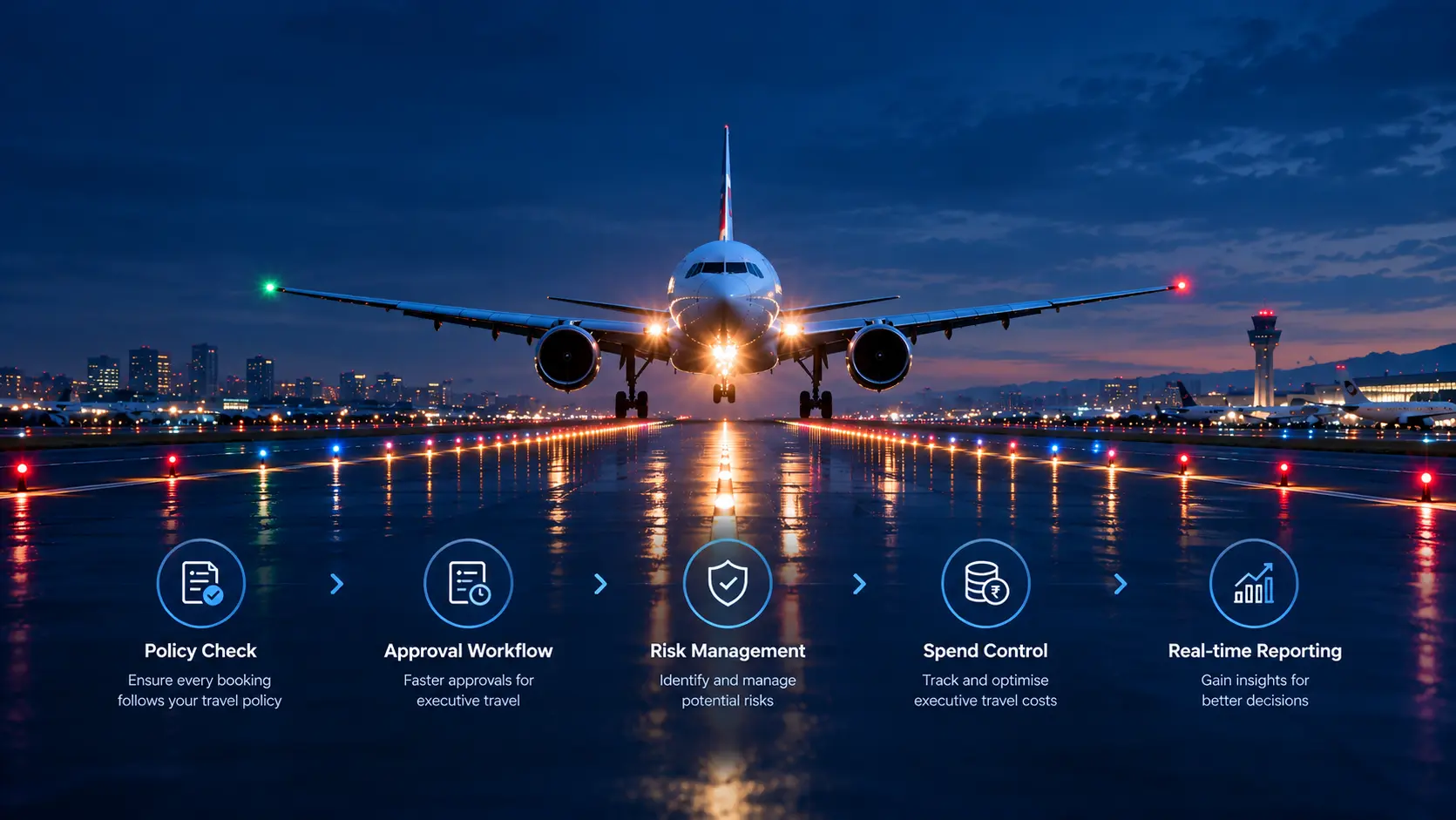
- Policy-based booking prompts
- Automated approval routing
- Real-time compliance alerts
- Digital expense reconciliation
Automation supports speed without sacrificing oversight.
Step 4: Train Executive Assistants
Executive assistants often manage travel logistics.
Training them on:
- Approved booking channels
- Policy exception categories
- Documentation requirements
- Risk protocols
Improves compliance dramatically.
Step 5: Communicate the Why
Executives respond better to rationale than restriction.
Frame compliance as:
- Governance protection
- Risk mitigation
- Financial transparency
- Reputational safeguarding
When CXOs understand the strategic importance of travel compliance, adoption improves.
The Strategic Impact of CXO Travel Compliance
When implemented well, CXO travel compliance delivers measurable benefits:
- Reduced audit risks
- Improved budget forecasting
- Stronger supplier negotiations
- Faster approvals
- Enhanced executive safety
It also strengthens alignment between finance, HR, and leadership teams.
In many organisations, executive travel is a blind spot. Once brought under structured governance, it becomes a source of insight rather than uncertainty.
The Role of Technology in Executive Travel Governance
Technology is reshaping travel compliance at every level.
Advanced travel management platforms now offer:
- AI-driven policy enforcement
- Real-time spend analytics
- Centralised booking platforms
- Risk intelligence integrations
- Executive-level reporting dashboards
For large enterprises, these tools transform CXO travel from a reactive administrative task into a controlled strategic function.
FAQ: CXO Travel Compliance
What does CXO travel compliance include?
It includes policy adherence, approval workflows, expense management, risk monitoring, vendor compliance, and audit documentation for executive-level travel.
How is executive travel different from regular business travel?
Executive travel typically involves higher costs, increased security risks, faster approval requirements, and greater reputational exposure. It often requires more flexible but controlled compliance mechanisms.
Why is executive travel governance important?
It supports corporate governance, reduces audit risk, ensures financial transparency, and protects organisational reputation.
Can CXOs be exempt from corporate travel policies?
While executives may have higher flexibility thresholds, complete exemption increases financial and reputational risk. Structured exception management is more effective than blanket exemptions.
How can organisations improve CXO travel compliance?
By segmenting policies by role, automating approvals, integrating travel and expense systems, training executive assistants, and implementing real-time analytics dashboards.
Final Thoughts: Compliance as Strategic Protection
CXO travel compliance is not about restricting leadership mobility.
It is about protecting governance standards while enabling executives to operate at full speed. When organisations treat executive travel as a strategic function rather than an administrative afterthought, they gain visibility, control, and confidence.
If your organisation lacks clear executive travel oversight or struggles with policy exceptions, now is the time to address it.
Contact our team to assess your current executive travel framework and discover how a modern, real-time travel and expense platform can strengthen compliance without slowing leadership. Book a demo today and bring clarity to your executive travel governance.