

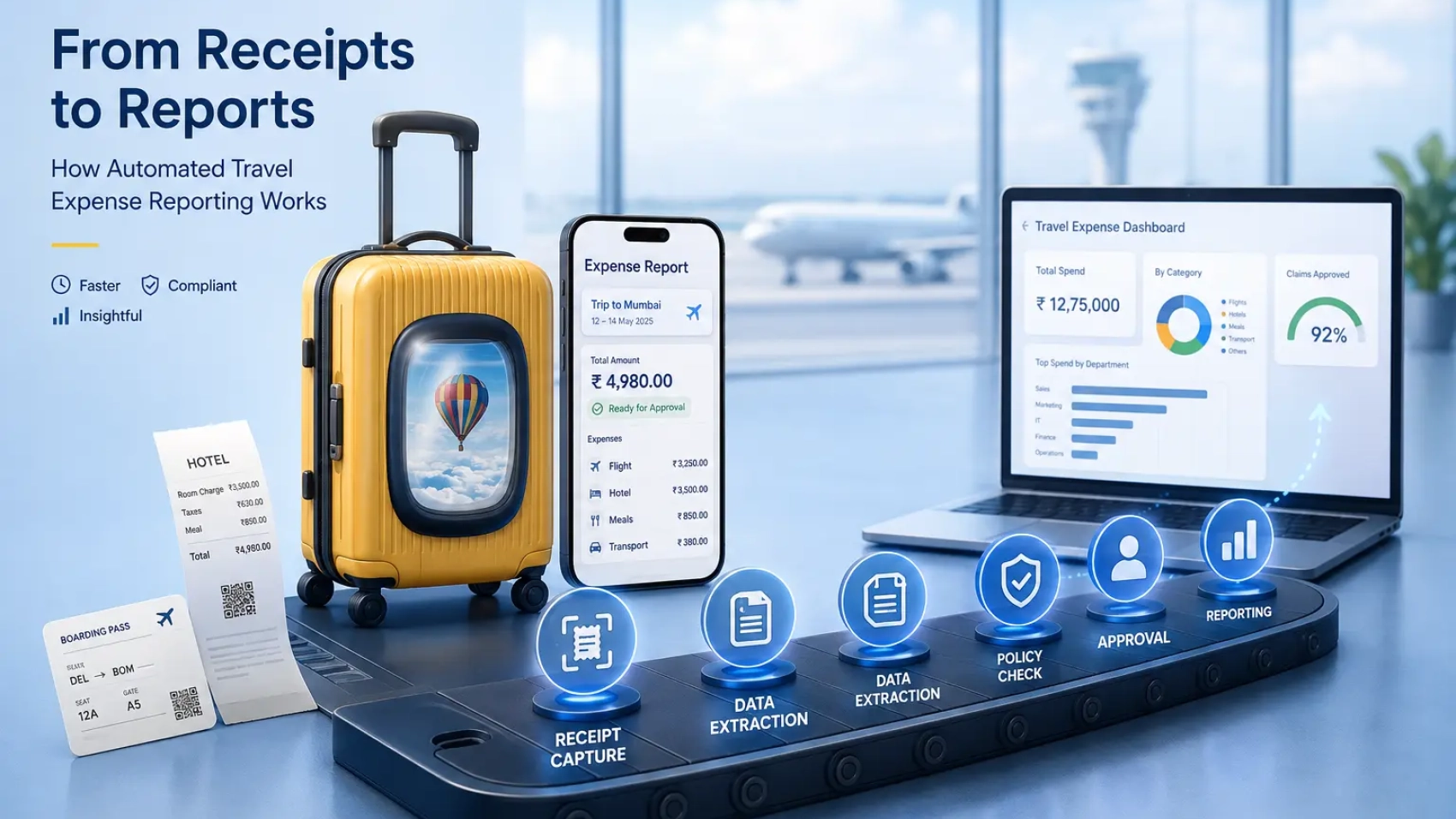
A business trip does not end when an employee reaches home. For the finance team, that is often when the real work begins.
Receipts need to be collected, expenses categorised, claims checked, policies reviewed, approvals completed, and information transferred into financial systems. When these steps are handled manually, a simple business trip can create days of administrative work.
Automated travel expense reporting changes that process by connecting travel data, receipts, expense claims, policy checks, approvals, and financial reporting in a more structured workflow.
The result is not simply faster expense processing. Finance teams gain better visibility into business travel spending, employees spend less time preparing claims, and organisations have more reliable data for financial decisions.
Why Travel Expense Reporting Becomes Difficult to Manage
Managing a small number of employee expenses manually may seem manageable. The problem appears when travel volume increases.
An employee may book a flight through one channel, pay for a hotel using a corporate card, take a cab, claim meals, and submit several receipts after returning. Each expense may contain different dates, amounts, tax details, currencies, and supporting documents.
Finance teams then have to determine whether everything is accurate and compliant.
Common challenges include:
- Missing receipts
- Duplicate expense claims
- Incorrect expense categories
- Delayed submissions
- Manual data entry
- Policy violations
- Slow approval cycles
- Difficult reconciliation
These issues become harder to control when travel information and expense information sit in separate systems.
Modern travel and expense management therefore focuses on connecting the entire process rather than treating expense reporting as an isolated accounting task. Platforms such as SAP Concur, for example, connect travel bookings and expenses to improve visibility, policy compliance, and control across the travel lifecycle.
What Is Automated Travel Expense Reporting?
Automated travel expense reporting uses software to collect, organise, validate, and process business travel expenses with less manual intervention.
Instead of employees entering every detail from scratch, the system can capture information from receipts, bookings, transactions, and other connected sources.
A typical automated workflow looks like this:
Travel booked → Expense incurred → Receipt captured → Data extracted → Policy checked → Report prepared → Approval → Finance processing → Reporting
The exact workflow varies between platforms, but the principle remains the same. Information should move through the expense process without requiring employees or finance teams to repeatedly enter the same data.
This is particularly useful when organisations want to connect corporate travel management with expense management.
From a Paper Receipt to a Digital Expense
The first major change happens at the point where an expense is created.
Instead of keeping receipts in a wallet or folder and entering them manually later, employees can capture receipts digitally. Modern expense systems can extract information such as the merchant, date, amount, and other relevant fields.
This reduces the amount of typing required from employees.
For example, consider a ₹2,450 hotel meal expense.
With a manual process, the employee may need to:
- Keep the receipt.
- Open an expense form.
- Enter the merchant name.
- Enter the amount.
- Select a category.
- Enter the date.
- Upload the receipt.
- Submit the claim.
With an automated process, much of this information can be captured from the receipt and prepared for review.
Receipt capture and automated report creation are now common capabilities in travel and expense platforms.
The employee still needs to review the information, especially when something is unclear. Automation reduces repetitive data entry without removing the human decision-making that matters.
How Travel Data Gets Connected to Expense Data
Receipt capture is only one part of the process.
The bigger opportunity comes from connecting travel booking information with expense information.
Suppose an employee books a flight, hotel, and airport transfer through the company’s approved travel platform. That booking information already exists digitally.
When the corresponding expense is created, the system can use the available travel information to provide context around the transaction.
This can help finance teams understand:
- Which employee incurred the expense
- Which trip it relates to
- When the travel took place
- Which department should bear the cost
- Whether the booking followed company policy
- How much the overall trip cost
Connecting these data points creates a more complete view of corporate travel expenses.
It also reduces the need for employees and finance teams to reconstruct the details of a trip after it has ended.
Where Policy Compliance Fits Into the Process
Expense reporting should not be the first time a company checks whether spending followed policy.
A stronger approach is to apply policy controls throughout the travel lifecycle.
For example, a company’s policy might specify:
- Maximum hotel rates by city
- Approved travel classes
- Meal limits
- Permitted ground transportation
- Approval requirements
- Department-specific spending limits
Automated systems can flag expenses that fall outside defined rules for further review.
This does not mean every exception is automatically rejected. A legitimate business reason may exist. Instead, the system brings exceptions to the attention of the appropriate person.
That distinction matters.
Automation should make policy enforcement more consistent while still allowing authorised teams to review genuine exceptions.
What Happens During Approval?
Once an expense report has been prepared, it needs to reach the right approver.
Manual workflows often depend on employees knowing whom to email and managers remembering to review submissions. This can create unnecessary delays, particularly when managers are travelling themselves or working across different locations.
An automated expense workflow can route reports based on predefined rules.
For example:
Employee submits report → Manager reviews → Finance validates → Approved expense moves to processing
Approval rules can be based on factors such as department, expense amount, project, or organisational structure.
The benefit is straightforward. Finance teams spend less time chasing approvals, while employees have greater visibility into where their claims stand.
Why Automated Reporting Matters to Finance Teams
The value of automation becomes clearer when looking beyond individual expense claims.
Finance leaders need answers to larger questions:
How much are we spending on business travel?
Which departments are spending the most?
Where are policy exceptions occurring?
Are travel costs increasing on particular routes or destinations?
How much time is the finance team spending processing expenses?
Manual spreadsheets can answer some of these questions, but collecting and cleaning the underlying information takes time.
Automated travel expense reporting creates a more consistent stream of structured data. This allows finance teams to spend less time preparing information and more time interpreting it.
Connected travel and expense platforms increasingly focus on near-real-time visibility, reporting, and financial control for precisely this reason.

Automated Reporting Does More Than Save Administrative Time
Time savings are an obvious benefit, but they are only part of the story.
Better Data Accuracy
Reducing manual data entry can reduce common errors involving amounts, dates, categories, and duplicate entries.
Faster Reconciliation
When booking and expense information are connected, finance teams have more context when matching transactions.
Stronger Policy Control
Expenses can be checked against company rules before they become difficult to investigate.
Better Employee Experience
Employees spend less time completing repetitive expense forms.
More Useful Travel Analytics
Structured expense data can reveal patterns that are difficult to identify through disconnected spreadsheets.
This is why travel expense automation should be viewed as a financial control mechanism as well as an administrative tool.
What a Modern Automated Travel Expense Workflow Looks Like
Consider an employee travelling from Chennai to Mumbai for a two-day client meeting.
The employee’s flight and hotel are booked through the company’s corporate travel platform.
During the trip, the employee incurs expenses for meals and local transportation. Receipts are captured digitally rather than stored until the end of the trip.
The expense system collects the relevant information and associates the expenses with the employee’s trip.
The system then checks the claims against company policy.
An expense within policy can move through the normal approval process. An unusual or out-of-policy expense can be flagged for review.
Once approved, the relevant data can be passed to the finance system for further processing.
Instead of reconstructing the trip from receipts and emails, Finance receives a connected record of what was booked, what was spent, and what was approved.
That is the practical difference between automated expense reporting and simply digitising expense forms.
Where Automation Still Needs Human Oversight
Automation does not mean that finance teams should stop reviewing expenses.
Some situations require human judgement.
For example:
- A client dinner exceeds the standard meal limit.
- An employee has an emergency expense during a travel disruption.
- A receipt is incomplete.
- A transaction cannot be matched confidently.
- A business expense requires special approval.
The purpose of automation is to handle predictable, repetitive work consistently while directing exceptions to people who can make the right decision.
This human-in-the-loop approach is important because business travel rarely follows a perfectly predictable pattern.
Research into automated corporate expense processing similarly highlights the value of combining receipt recognition, policy-based classification, automated processing, and human review for exceptions.
What Finance Teams Should Look for in an Automated Expense Solution
Not every expense platform will work equally well for a corporate travel programme.
When evaluating a solution, consider whether it can connect the complete travel and expense lifecycle.
Look for capabilities such as:
- Digital receipt capture
- Automated expense categorisation
- Travel booking integration
- Policy controls
- Approval workflows
- Duplicate detection
- Finance system integration
- Travel spend analytics
- Centralised reporting
- Mobile access
The important question is not simply, “Can this system automate expense reports?”
A better question is:
“Can this system give us a reliable view of the complete business travel spend?”
That distinction can make a significant difference as the organisation grows.
Turning Expense Data Into Travel Intelligence
Once travel and expense information are connected, organisations can start asking more useful questions.
For example, a finance team may discover that:
- Certain routes consistently generate higher travel costs.
- Some departments have higher rates of policy exceptions.
- Hotel spending varies significantly between locations.
- Employees frequently book outside preferred channels.
- Certain travel categories are increasing faster than expected.
These insights can inform future travel policies, supplier negotiations, budgeting, and approval rules.
This is where travel spend analytics becomes valuable.
AtYourPrice’s Travel Spend Analyzer follows this broader principle by helping organisations connect travel activity with spending information so teams can track, analyse, and optimise their corporate travel programme.
The Future of Automated Travel Expense Reporting
Travel expense reporting is moving toward a model where employees provide less manual input and finance teams receive information sooner.
The direction is already visible across the market. Major travel and expense platforms are combining automated receipt capture, policy controls, report creation, integrations, and analytics into connected workflows.
The next stage will likely involve more intelligent handling of exceptions, stronger connections between booking and expense data, and greater use of real-time information for financial decisions.
For businesses, the objective remains simple: make travel spending easier to capture, easier to control, and easier to understand.
Frequently Asked Questions
What is automated travel expense reporting?
Automated travel expense reporting uses software to capture expense information, prepare reports, apply policy checks, route approvals, and organise data for finance teams with less manual work.
How does automated expense reporting work?
A typical process captures receipts or transaction data, extracts relevant information, associates expenses with a trip, checks company policies, routes the report for approval, and sends approved information for financial processing.
What are the benefits of automating travel expense reports?
Key benefits include reduced manual data entry, faster approvals, better expense accuracy, stronger policy compliance, easier reconciliation, and improved visibility into business travel spending.
Can automated expense reporting reduce errors?
It can reduce errors associated with repetitive manual entry and incomplete information. However, exceptions and unusual transactions may still require human review.
Can travel expense software integrate with accounting systems?
Many modern travel and expense platforms offer integrations with finance and accounting systems. When evaluating a platform, businesses should check whether it supports their existing financial workflows and required data fields.
Is automated expense reporting suitable for small and medium-sized businesses?
Yes. SMEs can benefit from automation because finance teams are often managing multiple responsibilities with limited administrative resources. The right system can reduce repetitive work while providing better control as travel volume grows.
Conclusion
Travel expense reporting sits at the intersection of employee experience, financial control, and corporate travel management. When the process depends on receipts, spreadsheets, emails, and manual reconciliation, valuable time is spent moving information from one place to another.
Automation changes that workflow.
By connecting travel bookings, receipts, expense claims, policy controls, approvals, and reporting, organisations can build a clearer picture of where travel money is going and why.
For finance teams, that means fewer repetitive tasks and better data. For employees, it means simpler expense submission. For business leaders, it means greater visibility into one of the most important areas of corporate spending.
AtYourPrice brings corporate travel management and travel spend visibility together, helping businesses manage bookings, approvals, policy compliance, invoicing, and travel analytics through a connected platform.
Want to see how automated travel management can simplify expense reporting and give your finance team better visibility into corporate travel spend? Book a Demo with AtYourPrice and explore how the platform can fit into your organisation’s existing travel and finance workflow.